Century of Spinning Plastic Discs

By Wayne Shevlin

Opening salvo of the 21st century: announcing the end of the copy economy – sunset on the century of spinning plastic discs.
imageResize[1]

Viktor Vasnetsov – Grave-digger (1848 modified by WS) – Public Domain   

The Byrds once advised aspiring rock n’ roll stars: “Sell your soul to the company, who are waiting there to sell plastic-ware”.  The goal was crystal clear: multi-platinum.  “The name of the game, boy – we call it riding the gravy train”. That meant millions of copies. Copies of plastic discs.  Plastic discs that must be pressed, be warehoused, be shipped, unpacked & racked, sold and be played.  Millions upon millions of plastic discs – they formed the basis of my personal existence and shaped the culture of my generation for many decades.  They were also the foundation of an entire industry.  An industry based on the unquestioned premise that copies had value.  And now they don’t.

Running a record section in late 1970s New York City we knew all these plastic discs by their catalogue numbers – it was a matter of pride:  Billy Joel’s The Stranger, the first Boston album, Frampton Comes Alive and the Saturday Night Fever soundtrack.  You may wrinkle your nose, but these were monsters.  They arrived by the truckload.  The boxes lined the walls and filled every available corner of the shop.  We ran out of room.  I threw my back out lifting them all.  Records had weight, let me tell you.  When an album hit it big, you knew about it – physically.   Queues stretched out the door and around the block.  In the surreal rush of a hot new release we were the shamans. We had the mojo everyone was desperate for.  We had gravitas and impact because we were the source – the only source – of the plastic discs.

You could see the sense of awe in peoples’ faces as they held the latest big album in their hands for the first time.  We felt real pride in getting the hot new music to the people.  My father queued up at midnight for the release of The Beatles White Album.  And now, strange as it seems, these once ubiquitous plastic discs are now nothing more than the artefacts of a bygone culture – mine.  They are now relegated to curios that might be dug up by an archaeologist.  Once upon a time, in a place far away, these things really mattered.  How sweet.  How sad.

Once, a serious music collection made a design statement: ceiling high spines of vinyl LP album sleeves replacing the need for wallpaper.  Alan P’s entire flat was wall to wall coloured cardboard in milk crates.  Nowadays, this personal statement of his intense commitment to music would fit in his shirt pocket.  Kind of loses its impact.  Hard to point at it with pride and impress your date by saying “that’s mine”.  (Probably didn’t impress your date back then either, but we always hoped for the best.)  A thousand vinyl albums against a wall had gravitas.   Sharing your space with them proved that you really cared.  It said something about you personally.

Vinyl was superseded by the CD – the new, modern plastic disc.  The CD heralded a new age and an extraordinary renaissance where, for over a decade,  music spanning the entire 20th century was dusted off and given a new lease on life.  New music continued to be created and thrive while, simultaneously, three older generations re-purchased the music of their youth.  I kept an eagle-eye out for über niche artists, waiting for them to make their way to the top of the re-issue schedule: Morton Subotnick’s Silver Apples of the Moon, Passport’s Cross Collateral, Gentle Giant’s In a Glass House, and hundreds of others equally obscure. And they all appeared eventually. And then, when the concept of re-mastering became the rage, we waited and bought many of them all again.  How many industries can convince their customers to buy the same thing three times in this way?  The 90s music industry wallowed in sheer mania of it all.  Boy – that was a gravy train.  And now it’s over.  And it won’t happen again.

It won’t happen again because the CD was not just another kind of plastic disc like the 78, the 45 and the LP before it.  The CD was – as it turned out – a Trojan horse.  The CD had – hidden within its friendly, familiar plastic disc persona – the razor sharp teeth of digital bits.  Shiny and round, it masked the truth about itself.  It was not just a copy.  It was a clone. What it contained could be set free from the plastic, every bit as good as the bits that originally made it – the music was not bound to the media. The CD put a digital production-master of its content into the hands of anyone who held it.  Ironically, its very power made it valueless.  The media was no longer the message.  The media was superfluous and the copy had no value.  If CD began the process, then the online digital file completed it: from media is the message to media superfluous to media non-existent.  MP3 killed the value of the copy and signalled the death of the artefact.

Are artefacts important at all to this new generation?  For these digital natives, is there any value in stuff – or does mere access to content trump ownership?  Music is now just bits in the ether.  A 60GB MP3 player may contain the same content, but it is not the equivalent of Alan P’s ceiling high wall of vinyl.  How do we now show our intense, personal commitment to music?  Do we have one?   Somewhere we lost the gravitas.  We lost the mojo.  We lost the love of the artefacts.

Spinning plastic discs: they’re so 20th century, really.

A Whisper That Roars

By Wayne Shevlin

I’d like to celebrate the microphone and the revolutionary impact it has had on music.

A-Collection-of-Twelve-American-Modernist-Microphones-ca.-1925-1946-est.-25000-35000[1]

As technology, the microphone is a marvel: converting into electricity the invisible, minute air pressure waves – what we in our mind’s ear perceive as sound – so that the very essence of sound can be captured and AMPLIFIED.   Yet, however fascinating the technology, history and development of the microphone; however crucial its role in the very existence of audio recording, these are not the aspects I want to explore here.  What I am interested in is the fundamental way in which the microphone has changed music in artistry, aesthetics and style.

In the beginning, the microphone was used merely as an extension of the ear.  It was placed where an ear would normally be, essentially hearing on the ear’s behalf.  But soon, microphones became pioneers, exploring sonic landscapes – going where ears could not go, capturing sound from unusual perspectives and contexts.  From these unique vantage points the microphone creates new sounds and new ways of hearing sound.  It allows unnatural sonic relationships to exist.  With a microphone, the most delicately quiet sound can be highlighted, isolated and elevated to soar above the loudest cacophony.   The microphone allows a whisper to roar.

Without the microphone, naturally quiet sounds require turning down the volume of the surrounding soundscape to be heard.  This directly affected the way music was composed prior to its invention.  In a Mozart flute concerto, the orchestra must lower its volume when the flute plays lest the flute be drowned out.  Mozart deliberately arranges the instruments so that the flute will be heard.  Perhaps the brass cease playing and the violins go pizzicato – maybe it’s a good time for a harpsichord accompaniment.  Flute themes in classical music are seldom set against a thunderous accompaniment because the physics are simply against it.

Even on one leg, Ian Anderson suffers no such impediment because he plays his flute through a microphone.  His lone flute can soar above the bludgeoning onslaught of 120 decibels of electric guitars and drums (which are also amplified using microphones with a resulting change in musical impact) .  With a microphone, Ian Anderson can write music for flute, not as a sweet sound set against light accompaniment, but as a screaming banshee wailing through a maelstrom.  The microphone gives his flute a new character, elevates its sonic relationship with the rest of the band and he writes a different style of music as a result.

Singing has been even more profoundly impacted by the microphone.  In the past, when the fat lady sang, she was attempting to reach the upper stalls of the opera house on the strength of her natural vocal power alone.  This requires a style of singing that, by necessity, must have a high degree of concern for projection.  That’s why opera singers sing that way: larynx wide open, deep from the diaphragm.  They need to reach the gallery.  Power, volume, projection: to be heard above the orchestra (which, must still tone down) – these are the key qualities for opera singing.  And the operatic style reflects this.  It is instantly recognisable. Nuance and delicacy are, to a great extent, sacrificed for power and volume.

And before a clutch of opera buffs huff and puff that, “damn it, opera is full of nuance and delicacy”, please consider the singing style of Billie Holiday.  That’s the kind of delicacy I’m talking about:  a whisper – a vocal teardrop – a sigh that shimmers above the hot brass.   The microphone allows the most intimate vocal style – normally only appropriate for the smallest of spaces – to fill the grandest hall.

When a mother sings a whispered lullaby in her baby’s ear, it has a particular sonic impact.  The relationship between the sound and the baby – the distance between mother’s mouth and baby’s ear – is natural and appropriate.  Filling Wembley Arena with exactly the same sound, but at the volume of a jet engine, changes the sonic impact on the listener and the meaning of the lullaby. The medium is the message.  A whisper heard as a roar acquires new meaning – and becomes a new kind of music.

The microphone creates an unnatural relationship between the listener and the original source of sound. If the microphone is considered an extension of the listener’s ear then it is worth noting that the microphone may be less than an inch from the singer’s mouth and captures the nuance of the voice in that aural space.  Sound is air pressure waves in motion and the sound emanating immediately from a singer’s mouth is high pressure indeed.  Other than babies listening to their mothers’ lullabies, we do not typically listen to singers at such a close proximity.

Singers are aware of the unnatural relationship between their voices and the listener and have developed specific techniques to avoid – and take advantage of – the sonic peculiarities resulting from, effectively, placing the listener’s ear directly in front of their mouths.  Good singers play their microphones like an instrument.  They take advantage of the increased bass when the microphone is close but avoid sibilance (ssssssss’s). They use the detail the microphone captures for dramatic effect.  They vary the distance of the microphone from their mouth to achieve consistency in volume – so that belting out the chorus and humming the softest verse are equally loud.  The microphone has created a new style of singing that is as demanding and specific as that of the opera singer, but completely different in perspective and technique.

A sonic impossibility that we have all come to take for granted is the sound of the drum set.  Today, drums are routinely amplified by placing microphones directly against cymbals and inside the drums.  Though these are mixed to create a holistic drum set, nonetheless the actual sound is completely artificial.  We do not normally listen to drums by simultaneously sticking our heads directly next to the crash cymbal and inside the bass drum.  However, nowadays, this is what we expect drums to sound like.  A drum set mic-ed as we would normally listen with ears – at least 10 feet in front – would sound empty and hollow.  Without the artificial mic-ing technique, heavy metal would simply not have the requisite weight to satisfy the righteous head banger.

Music has always been a reflection of and an adaptation to the available sound producing technology of the time.  The evolution of musical instruments from hollow logs to brass tubes to digital synthesisers has, on the one hand, been a response to the needs of musicians and yet, on the other, has set the limitations on the sounds they could create.  This, in turn, defines the style of music created.  This is a quality not generally associated with the microphone; that it is not merely a passive receiver, but creates sound as much as does a saxophone; that it has changed the course and style of music.  That it is an instrument in its own right.

Tools of the Trade… Al Levitt’s 100th birthday

The Hounds newest contributor Wayne Shevlin celebrates  NYC’s finest for   Al Levitt’s 100th birthday.   Enjoy!!

by Wayne Shevlin

imageResize[1]

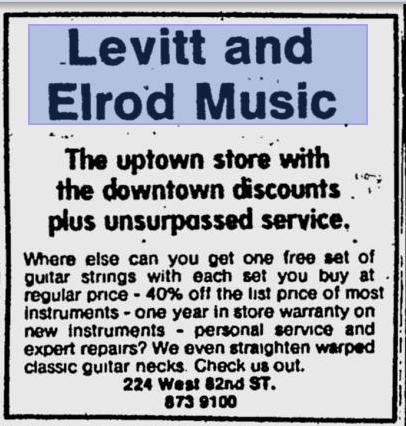
One of the first pit stops along my musical road was to work during the late 1960s & early 70s for Levitt & Elrod, a musical instrument sales and repair shop on NYC’s Upper West Side.  Sad, perhaps, but my idea of fun as a 13 year old was hanging around L&E looking at music folios and guitars for hours on end – almost every day.  I’m not sure of his motives (perhaps it was just to get me the hell out of the store) but one day Syd Elrod, who handled selling out front, offered me fifty cents to deliver a French horn to the public school down the block – which I did.  Shortly thereafter I had a regular job working after school and on Saturdays.  It started with sweeping, deliveries and other mundane tasks, but it wasn’t long before I was entrusted with selling accessories – and soon instruments as well.

Syd was the ebullient, friendly outward face of L&E, selling and renting instruments.  But hidden in the back was Al Levitt, the repairman, a musical surgeon who never emerged unless a repair job was so serious that only a personal consultation with the frantic musician would suffice.  Al was very highly respected, and was relied upon by many of the top jazz and orchestra players in NYC including Michael Kamen, Julius Baker and Lee Konitz among many others. He specialised in wind and reeds but, really, he could repair anything (except electric guitars and amplifiers. Hah!  A niche for me perhaps?).  At any one time there would be literally dozens of instruments – from flutes and saxophones to tubas and double bases – lying in bits in the midst of valve replacement or some other surgery. It was from Al that I learned about the guts of musical instruments and what was involved with keeping them alive

Al was a thin, angular, sharp faced man who wore, along with fearsomely distorting horn rimmed spectacles, a magnifier head visor which he kept perpetually perched on his brow, sliding it down over his glasses to inspect the patient.   Al’s workshop, in the back of the store, seemed to always be pitch dark except for a Bunsen burner and variety of small but very bright lights branching like tentacles from his workbench. His workbench – a huge, long thick slab of wood like a mediaeval castle door – was completely customised by Al to suit his own needs,  festooned with all manner of shelves, storage drawers, trays, clips, loops, hooks and holders to hold parts and tools.  Every tool had an official place and was positioned so that it could be reached without him having to budge an inch from his chair.

Wind and reed instruments – such as flutes and saxophones – employ pads which are raised and lowered by keys.  The enemies of wind and reed instruments are sticky keys and pads that leak air – no matter how tiny the leak.  Al found air leaks not by blowing, but with light.  Attaching a light-bulb to the end of a long, stiff but flexible wire, he could snake the light through the instrument, press the pad down and expose even the most infinitesimal leakage as the peep of light would show through – sort of an alto sax colonoscopy.  With his vast array of pivot screwdrivers, needle-nose pliers and other tools Al could bring practically any instrument back to life.

And woe betide you if you tried to touch or looked like you were even thinking of touching his tools.  And don’t dare ask to borrow Al’s tools.  “DON’T TOUCH MY TOOLS!!”  Righteous anger – and no joke.  “My tools are my bread and butter.”  Bread and butter.  Indeed.  I came to understand how tools – which include musical instruments, hammers, fountain pens and bicycles – when used by a serious artisan, mould and adapt to their user’s unique technique and feel. The pressure and balance are just so.  And, if used by someone else – even a skilled user (let alone a clumsy dolt) – these delicate nuances can be compromised.  Or the tool might get damaged.  Or lost.  They will be sorry – but you will be sorrier.  Hence, I would not be insulted if someone wouldn’t let me “try his guitar” – and similarly I hope he won’t be insulted if I don’t let him “try mine”.  You may imagine my pride then when, some years later – when I had begun repairing electric guitars for L&E – and I really needed to borrow a tool of his, that Al trusted me enough to lend it to me.  The look in his eye made the weight of my responsibility crystal clear and you may be sure it was returned in immaculate condition immediately upon my finishing with it.

It was a bit of an event when a repaired or overhauled instrument was returned to its owner – particularly when that owner was someone famous.  The really big stars were invited back to Al’s workshop, but other times Al would emerge from the gloom of his catacomb with the newly restored instrument gleaming in his hands to personally present it to its owner.  He would explain in detail the intricate work that had been done and if he had run into unexpected difficulties he would relate, as if a tale of adventure, the daring do required to rescue their instrument from the shadow of death. The honest gratitude on the owner’s face was inevitably quite humbling.  Al would then quickly double check the instrument by playing a flurry of scales – lest the repair had mysteriously vanished while waiting in the case – and then would hand it over to the grateful musician who would road test it for themselves by treating us to an impromptu performance right there in the shop.

My impression then and my memory now of Al was this gnarled old man in his workshop, hunched in the dark over an open flame, peering through those bizarre head visors, surrounded by his tools, soldering a joint or delicately adjusting a screw to rescue another musical instrument.  It certainly had something gothic about it, like Dr Frankenstein’s lab. Al was fierce and sometimes I felt like Igor or Mickey Mouse.  However, I was not an apprentice and Al never gave me any lessons. But just by observing him I learned not only how to build a workbench and many techniques for fixing instruments, but the workman’s ethic.  I now realise that many of the qualities that I admire and aspire to, I learned from Al: his approach to problem solving, his diligence and patience, his intense dedication to quality, the consistent quality of his work, his integrity and honesty (he never gouged anyone – his prices were always fair).   I can’t say that I am always successful in achieving all of these qualities but I can’t think of a better role model for a young boy regarding what it takes to be a good workman than Al Levitt.

Since those days at Levitt & Elrod I have had a few workbenches of my own, both personally and professionally.  Guess what?  I built them exactly the same way Al did.  I now have a magnifying head visor of my own – Russian, purchased for £5 in Brighton no less – which I use to repair B’s jewellery (a never ending career).  These days I no longer work professionally with screwdrivers and needle-nose pliers, but with a keyboard and a mouse.  But my office is dark, and everything I need is within easy reach. My colleagues sometimes comment on the cave like quality of my office – “Wayne, it’s so dark in here”.  Well – now you know.  It may look like just an office desk with a computer to you, but to me, this is my workbench – Al Levitt style.


BBC Radio-90 Years Old- 5.33pm Nov 14 2012

Today Wednesday 14 November the BBC marks the 90th anniversary of its first broadcast by playing a specially commissioned composition by Damon Albarn to radio listeners around the world at 1733 GMT.

More than 55 BBC radio stations will come together for Radio Reunited – the first attempt at a simultaneous broadcast since what was then the British Broadcasting Company was formed in 1922. Each BBC station will play the composition, entitled 2LO Calling – a combination of specially written music, iconic sounds from radio’s past and present, and messages to the future from listeners around the world.

You can download the piece and find out more about the 90th anniversary by going to www.bbc.co.uk/reunited

Neville Thiele (4 December 1920 – 1 October 2012)

On October 1st Australian audio industry icon (Dr Albert) Neville Thiele, OAM, passed away aged 91.

Neville was one of the most influential figures in audio, and is best known for his role in the development of the ‘Thiele-Small parameters’. As a consequence, virtually every loudspeaker in the world has a specification sheet with these parameters.

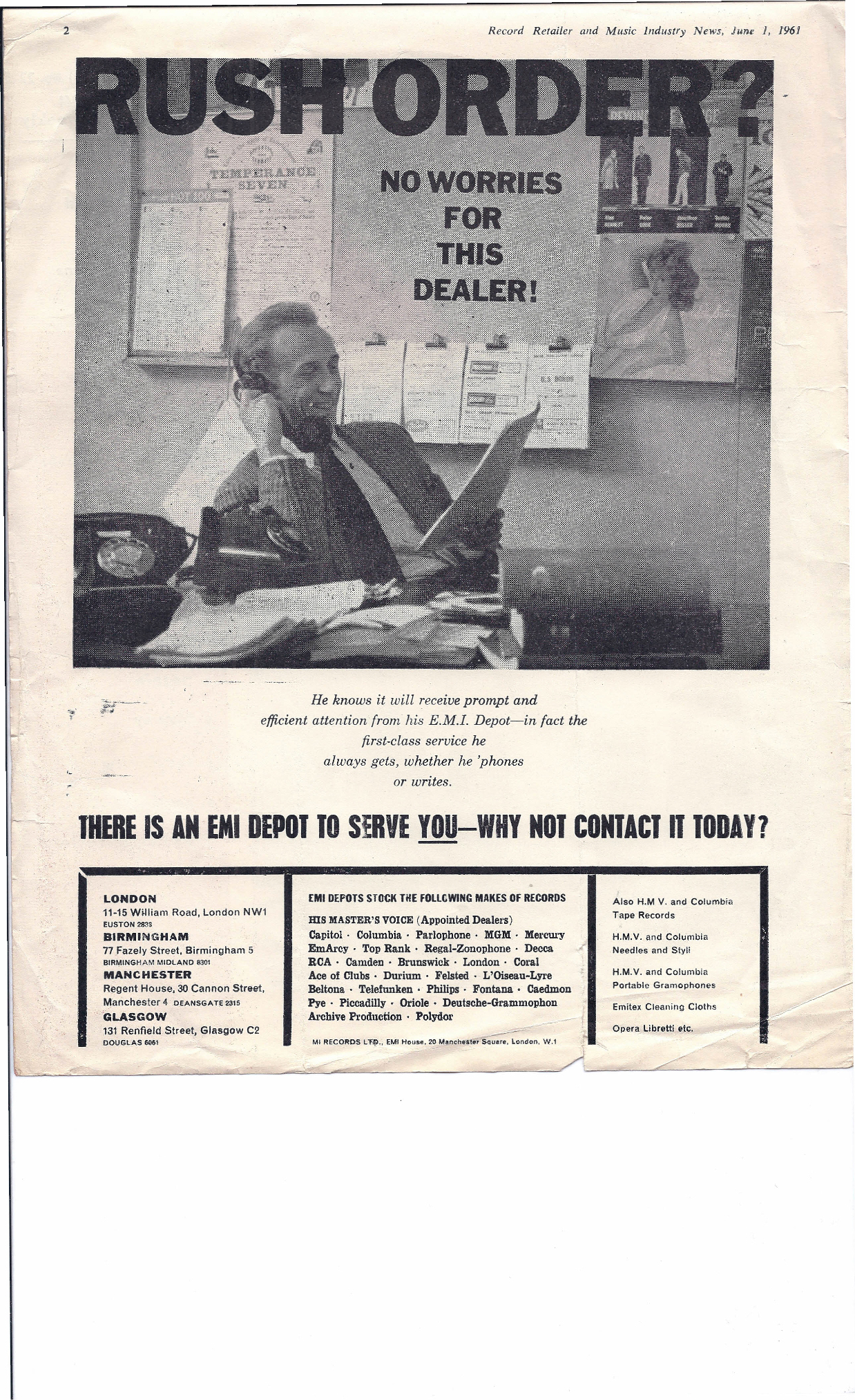
Joining EMI (Australia) Ltd., he was employed as a design engineer on special projects, including telemetry. With the start of television in Australia, he spent six months of 1955 in the laboratories of EMI at Hayes, Middlesex, and associated companies in Scandinavia and the United States, and on return to Australia he led the design team that developed EMI’s earliest Australian television receivers. Appointed Advanced Development Engineer in 1957, he was responsible for applying advanced technology in EMI Australia’s radio and television receivers and electronic test equipment.


Neville Thiele on Alan Blumlein

Mojo at Abbey Road – Electronic Music

Mojo ask Daniel Miller, Andy McCluskey, Martyn Ware, Mark Jones, Trevor Jackson, Matthew Herbert and Bill Brewster their thoughts on electronic music.

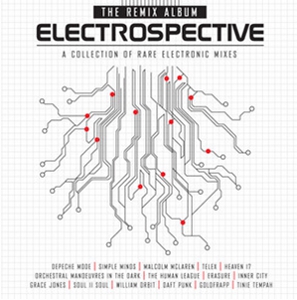
Electrospective-The Remix Album (2CD) release date 27 August 2012-  EMI Gold

shop.electrospective.com

Daphne Oram’s 1960’s Optical Synthesizer Oramics Machine – Electronic Music Pioneer

In the early ’60s, pioneering British composer Daphne Oram set out to create a synthesizer unlike any other, she called it the Oramics machine

Commissioned by The Science Museum, London. Directed, Produced, Filmed and Edited by Nick Street and Jen Fearnley.

Science Museum Oramics to Electronica: Revealing Histories of Electronic Music  Until Saturday 01 December 12  oramics.aspx