Science Museum September Talk by: Professor Adrian Thomas, Clinical Director for Radiology for South London Healthcare NHS Trust
Thursday 20 September 2012, 4 – 5pm
In 2009, the Science Museum’s centenary year, the public voted the x-ray machine as the most important object in its collections.
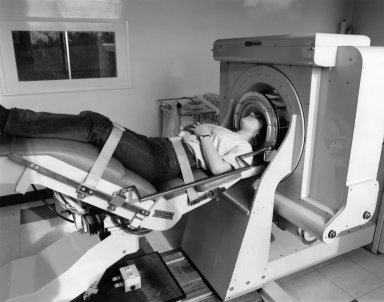
Arguably the CT (computerised tomography) scanner, which was announced to the public in 1972, is the second most important development in medical imaging. The CT scanner completely transformed medical practice by allowing 3D maps of the internal human body to be generated. There must be few now who have not benefited either directly or indirectly from this innovation.
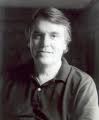
The story of the development of the CT scanner is fascinating, as is the life of its inventor Sir Godfrey Hounsfield FRS, whom the speaker met on many occasions. The prototype CT scanner was installed at Atkinson Morley’s Hospital and is now on display in the Science Museum’s Making the Modern World gallery. The talk looks at the historical and clinical context of the CT (EMI) scanner, and at the intriguing story of Godfrey Hounsfield, who left school with no qualifications and who ended up transforming medicine and receiving the Nobel Prize.
The talks will be in the Science Museum’s Lecture Theatre on the ground floor of the museum, are open to all and are free to attend. No booking is necessary and seats are available on a first come first served basis.
If you have any queries, or would like to be notified of future Science Museum Talks and events, please contact Selina Pang, Collections Coordinator at
The New Sound of Music is a fascinating BBC historical documentary from the year 1979. It charts the development of recorded music from the first barrel organs, pianolas, the phonograph, the magnetic tape recorder and onto the concepts of musique concrete and electronic music development with voltage-controlled oscillators making up the analogue synthesizers of the day.
Electronic Music Studios (EMS) EMS Synthesizers and equipment are a heavily featured technology resource in this film, with the show’s host, Michael Rodd, demonstrating the EMS VCS3 synthesizer and it’s waveform output. Other EMS products include the incredible Synthi 100 modular console system, the EMS AKS, the Poly Synthi and the EMS Vocoder. Most of the location shots are filmed within the BBC’s Radiophonic Workshop studios as they were in 1979.
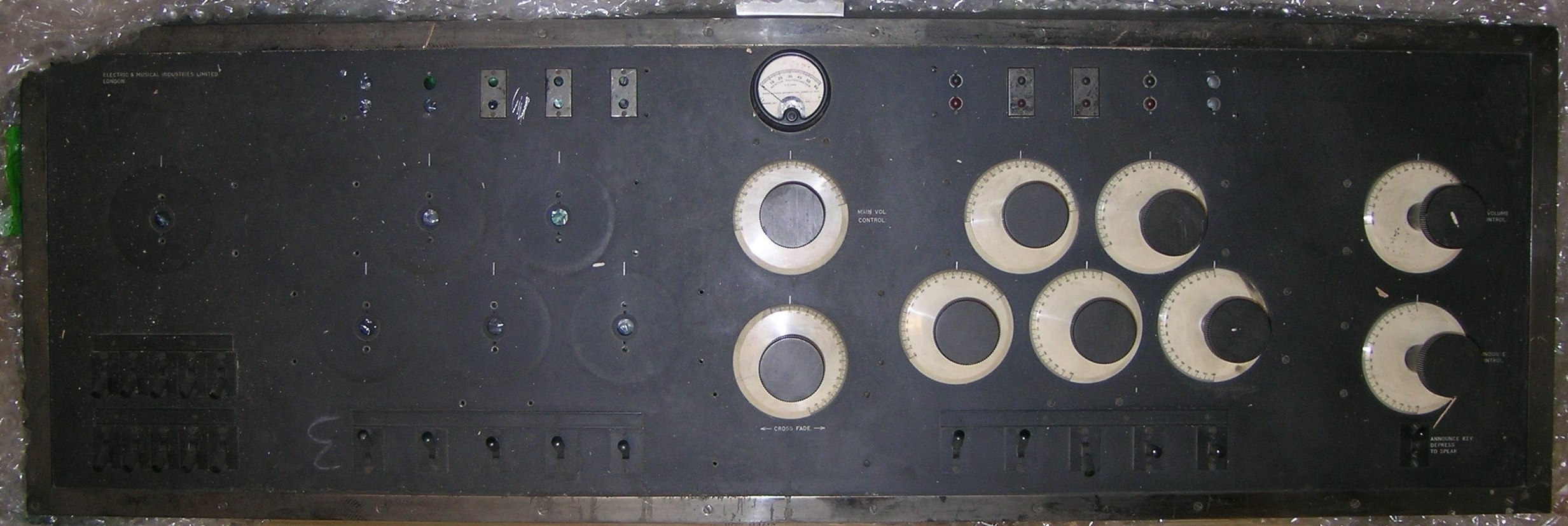
This mixer is the oldest-known EMI recording desk in existence. It was a bespoke design made for Abbey Road studios (then called the EMI Recording Studios Ltd.) When the studio complex was young, there was very little commercially-made studio equipment; so studios built their own. This desk is an early example of almost 50 years of EMI desk designs. (It is likely there were at least two more of these desks, as the studio had three main studios in operation.)
The desk has two “scenes” which are level settings for 5 microphones; one scene on the Left and one on the Right. The engineer would fade from one pre-set scene to the other using the centre fade control. This allowed quick transitions between microphone setups, as linear controls (now called faders) were not yet common.
Below each of the 5 level controls are on/off switches, with corresponding green and red lamps above to indicate the on/off setting for each input.
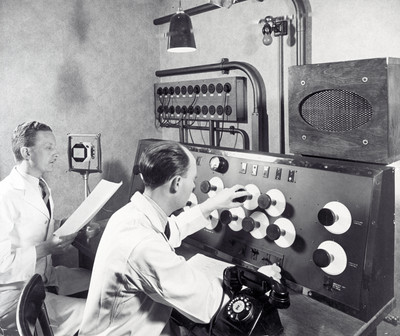
This photo shows the desk in use at Abbey Road in the 1940s, with staff engineers Laurie Bamber and Chick Fowler.
In 2006 I proposed to English Heritage that they put up one of their Blue Plaques in London to the music hall legend, Florrie Forde. They were enthused and started the apparently long and arduous task of researching her life and work and homes.
Florrie was born in Melbourne, Australia, in 1876 and ran away from home at sixteen to Sydney to go on the stage. There she was seen by a British star of the day who was touring Australia, GH Chirgwin and, encouraged by him, moved to London, where she made her debut at three separate halls on the same evening.
Her inexhaustible vocal power and engaging personality equipped her ideally to become queen of the music hall chorus-song – amongst them “Down at the Old Bull and Bush”, “Hold your hand out, naughty boy”, “She’s a lassie from Lancashire”, “Oh!Oh! Antonio”, “It’s a long way to Tipperary”, “Pack up your troubles in your old kit bag”, “Daisy Bell” (Daisy, Daisy, give me your answer do…), “I do like to be beside the seaside”, “Fair, Fat and Forty” and many more. She was also a famous Principal Boy in panto and starred in the first Royal Variety Performance in 1912.
Florrie Forde died in Aberdeen in April 1940 after entertaining wounded sailors. What a trouper. In his curmudgeonly poem, “Death of an Actress”, Louis MacNeice recalled her “elephantine shimmy” and “sugared wink”.
Now, six years on from my original proposal, English Heritage has just dropped her from their shortlist, with the explanation that their budget has been cut and that anyway she lived mostly at Shoreham-by-Sea in Sussex. While she was working? I don’t think so.
And what took them six years to discover this? No wonder their budget has been slashed.
In 1948 two Olympic Torches were made by E.M.I Ltd, designed by Ralph Lavers and donated to the Organising Committee of the XIV Olympic Games.
LONDON 2012 – the oldest 100-meter Olympic champion is back in London for the games. 89-year-old American, Harrison Dillard, was honored Wednesday at Britain’s Foreign Office where the 1948 EMI Torch from those London games is on display.
By: PAISLEY DODDS , first published by StarTribune, Associated Press, 1 August 2012
LONDON – The oldest 100-meter Olympic champion is back in London for the games — only this time as a celebrated athlete, not a scrawny kid from Cleveland who botched the hurdles only to win the gold in 1948.
Harrison Dillard, 89, was honored Wednesday at Britain’s Foreign Office where the 1948 torch from those London games in on display.
“It’s heavy!” the man, also known as `Bones’ because of his lanky youthful appearance, said as he held the silver torch.
As a world record holder, all eyes were on Dillard in 1948 to win the 110-meter hurdles. But when the day came, the American knocked down several hurdles and failed to finish the race.
He tried again in the 100-meter dash, winning in 10.3 seconds — a surprise to his teammate and favorite Barney Ewell, who did a premature victory dance thinking he had actually won.
Four years after London, Dillard went on to win the 100-meter hurdles in Helsinki.
“That’s one of the beauties of the Olympic Games, that they occur every four years,” Dillard told The Associated Press. “The athlete who fails in the first, assuming that he can maintain the necessary physical ability plus the emotional and mental ability, has a chance to redeem him or herself. I certainly had that good fortune.”
The 1948 games were the first time that Olympic judges had the benefit of using photo finish technology, which helps the naked eye in determining who crossed the finish line first.
Dillard, who now lives in the Cleveland suburb of Richmond Heights, said today’s athletes such as Jamaican sprinter Usain Bolt have benefited from advances in technology, equipment, medical knowledge and nutrition.
“He’s much bigger, stronger and much faster, of course, on the clock, but that’s not true only of Usain but all the athletes who are competing today,” Dillard said.
What’s the trick?
“Evolution,” Dillard laughed.
A lot has changed in Dillard’s life since he competed in the 1948 London games, held as Britain and the world struggled to recover from World War II.
“In my day, it was purely amateur. You represented your country, period,” he said. “They are now able to make it a profession.”
But London itself has also changed, said Dillard, who went on to work for the Cleveland Indians.
“It’s such a big city, almost monstrous,” he said of London. “Not like Cleveland, unfortunately, being an industrial city that has lost half its population and many of its industries.”
Dillard was inspired by another track and field athlete from Cleveland — Jesse Owens — who won four gold medals in the 1936 Summer Olympics in Berlin.
When asked what event he was most looking forward to this week, Dillard said it wasn’t the 100-meter dash.
“It’s my family getting here,” he said. “It’s the first time my daughter and three grandkids have ever been to London. It’s going to be a special time.”
Jon Lord obituary Organist who infused Deep Purple with classical influences, helping to make them one of the world’s biggest rock bands
Written by Joel Mclver, originally published by The Guardian, Monday 16 July2012
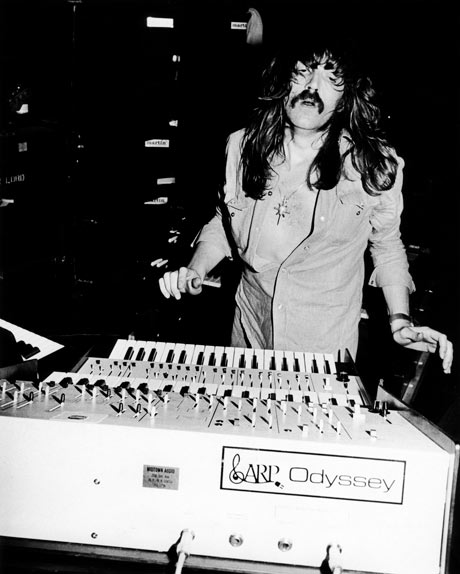
Jon Lord’s unique keyboard playing with Deep Purple was often copied. Photograph: Fin Costello/Redferns
‘We’re as valid as anything by Beethoven,” declared Jon Lord of his band, Deep Purple, in an interview with the New Musical Express in 1973. Lord, who has died aged 71 after suffering from pancreatic cancer, was not merely adopting a rebellious stance. An accomplished classical composer as well as rock musician, he believed with some justification that his group’s music was as profound in structure and as significant in cultural impact as any work from the symphonic canon. At the time, Deep Purple were among the world’s biggest rock bands, having built an enormous fanbase on the strength of their classically influenced songs, which lent further weight to Lord’s statement.
Born in Leicester, Lord studied classical piano from the age of five. In his teens, the then-new rock’n’roll and R&B movements made a deep impression on him, in particular the music recorded by blues pianists and organists such as Jimmy McGriff and Jerry Lee Lewis. The contemporary combination of Hammond B3 and C3 organs with Leslie speakers appealed to him, and this became an instrumental setup that remained integral to Lord’s signature keyboard style for the rest of his career.
In 1959, he moved to London to pursue acting, which he studied at the Central School of Speech and Drama. He played the piano and Hammond organ in clubs to pay the bills, initially with a jazz band called the Bill Ashton Combo and then with Red Bludd’s Bluesicians, featuring the vocalist Art Wood. While recording occasional sessions (he contributed keyboards to the Kinks’ 1964 hit You Really Got Me), Lord pursued pop success in the Art Wood Combo, who later renamed themselves the Artwoods and appeared on TV. I Take What I Want was the group’s only charting single.
Lord discovered his trademark sound when he formed Santa Barbara Machine Head, which also featured Wood’s brother and future Rolling Stone, Ronnie Wood. The key to this group’s success was its powerful, organ- and guitar-driven formula, which pointed at the future musical recipe of Deep Purple, and also the meeting of Lord and the bassist Nick Simper. The duo were the backbone of Deep Purple, who formed when the businessman and manager Tony Edwards invested in the new group and auditioned the cream of London’s young talent – the guitarist Ritchie Blackmore, the singer Rod Evans and the drummer Ian Paice among them. This quintet formed Purple’s first lineup in 1968.
Deep Purple spent the following eight years on a path that took them around the world on several occasions, playing the world’s largest stadiums and issuing a series of classic LPs – In Rock (1970), Fireball (1971), Machine Head (1972) and Burn (1974) among them. Personnel came and went, but Lord and Paice remained constant members until the group’s dissolution amid a haze of drug addiction and exhaustion in 1976.
Of the great British rock bands of the 70s, only Led Zeppelin, Black Sabbath and the Stones were able to operate on as grand a scale: unlike any of those groups, Deep Purple took regular time out to indulge in classical projects initiated and directed by Lord. The most notable of these was the live Concerto for Group and Orchestra, recorded at the Royal Albert Hall in 1969.
It was this equal passion for rock bombast and classical finesse that made Lord such an unusual musician. During Deep Purple’s glory days, he often infused the songs with classical influences, as in the song April from the group’s eponymous album in 1969. His organ playing, which often counterpointed Blackmore’s virtuoso lead guitar, was unique and often copied.
After the split, Lord formed a group with the rock singer Tony Ashton and Deep Purple’s ex-drummer Paice entitled Paice, Ashton & Lord. They released one album, Malice in Wonderland, in 1977. He then joined Whitesnake, the band formed by Deep Purple’s last lead singer, David Coverdale. This group, not to be confused with the 1980s reincarnation that played stadium rock and met with huge success, was an earthy, blues-rock band in which Lord’s organ playing was an essential element. His stint in Whitesnake ended when he rejoined a reformed lineup of Deep Purple in 1984 alongside Blackmore, Paice, the singer Ian Gillan and the bassist Roger Glover.
Many solo projects and collaborations came during and between Lord’s membership of these bands, including Before I Forget (1982), which featured classical piano music; a commission to compose the soundtrack of Central Television’s 1984 series The Country Diary of an Edwardian Lady; and guest spots on albums by rock luminaries such as Lord’s Oxfordshire neighbour George Harrison and Pink Floyd’s David Gilmour.
Eighteen more years of recording and tours followed before Lord felt he had had enough of life on the road. In a letter to his bandmates in 2002, he requested that Deep Purple take a year off. When this request was declined, he amicably left the group. Solo projects followed, including a collaboration in 2004 with sometime Abba singer Anni-Frid Lyngstad, and the formation of a blues band, Hoochie Coochie Men, three years later. In 2010, Lord was made an honorary fellow of Stevenson College, Edinburgh, and the following year he was awarded an honorary doctorate of music by the University of Leicester.
He is survived by his wife, Vicky, and their daughter, Amy; and a daughter, Sara, by his first wife, Judith, from whom he was divorced.
• Jonathan Douglas Lord, rock and classical musician and composer, born 9 June 1941; died 16 July 2012
• This article was amended on 18 July. Lord was with Deep Purple’s reformed lineup for 18 years rather than eight. This has been corrected.
SOTH would like to thank our latest contributor Michael Lloyd-Davies for his insightful review on the memoirs of Joe Batten – pioneer recording manager.
By Michael Lloyd-Davies
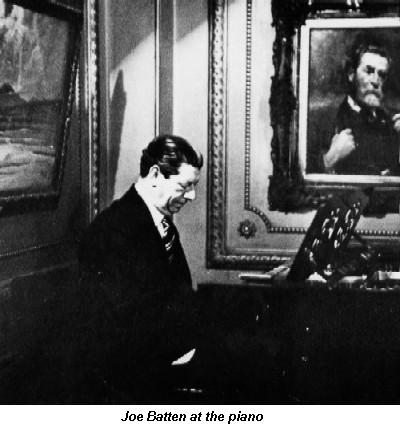
In his foreward to Joe Batten’s memoirs, Joe is described by Sir Compton McKenzie as “that other great recorder” bracketed with Freddy Gaisberg. Joe Batten’s story is perhaps wider in its horizons. The core of the book is the excitement of pioneer recording from wax-cylinder to L.P., in which mechanical hazards and progress are described as an explorer could write of his adventures.
The period before the First World War saw sound recording grow from being a novelty toy to become an industry full of innovation and eventually accepted as a serious medium and art form by both artists and the public.
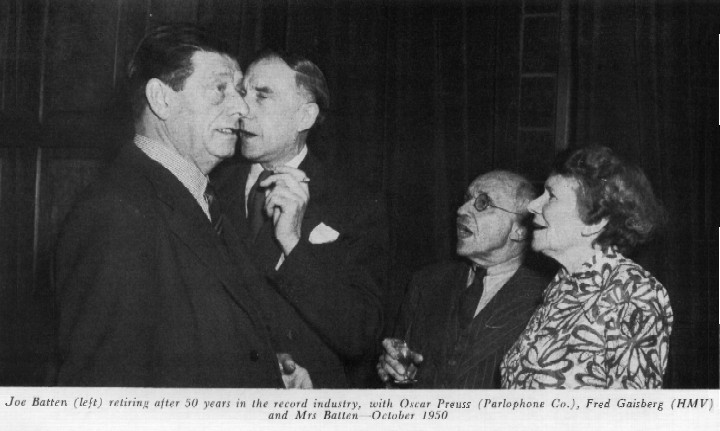
Joe was one of the pioneers who began as a pianist accompanying vocalists in recording rooms as early studios were known, to become the artistic manager for Edison Bell, and later, the Columbia Graphophone Company which merged in 1931 with The Gramophone Company to form Electric and Musical Industries Ltd (EMI).
At EMI he formed the Special Recording Department which was located at new studios at Abbey Road. This venture began making sponsored shows for the Commercial Radio companies which were springing up in the mid 1930’s. The department was almost immediately shut down at the outset of the Second World War but re-opened to make recordings for the troops through ENSA up to 1945.
In the last five years of his 50 year career in the music industry, Joe made some notable recordings including two historical events, the silver wedding of King George VI and Queen Elizabeth and the wedding of H.R.H. Princess Elizabeth and the Duke of Edinburgh.
Inevitably Joe Batten amassed a vast number of friends and memories in the musical concert and light opera fields and it is fitting that the book (out of print since the first edition in 1956) should close with select memories of the life and times at The Savage Club, London’s last bohemian rendezvous where Joe Batten concluded his life as he began it – accompanist to those spontaneous musical evenings which from the West End to the East were once such a feature of London Life.
Joe retired in 1950 but died five years later before his memoirs were published.
SOTH is delighted to welcome our latest contributor Brian Kehew who join’s our ever growing list of esteemed contributors. Brian is a LA based musician and music producer. He is a member of The Moog Cookbook and co-author of the Recording The Beatlesbook, an in-depth look at the Beatles’ studio approach. Kehew is also currently the Archives Historian for the Bob Moog Foundation. Enjoy!!
By Brian Kehew
Kevin Ryan and I spent about 15 years researching how the Beatles made their records – the technical and procedural side of things. Even with Abbey Road studios still in existence, the records and information there were incredible, but limited. We canvassed the rest of the world, seeking out anything that might illuminate the picture of that 1962-70 era. In our travels, we sometimes came across mention of “Hayes” or “CRL”, as in “They took that down to Hayes”, or “That was done at Hayes/CRL”. Both terms came up enough that we realised this Hayes-thing must be something to uncover. Whether it was a building, a town, or a company – we didn’t know at first.
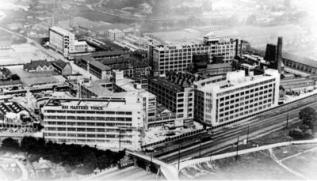
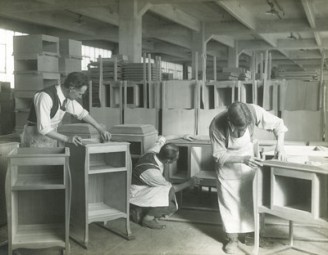
Eventually, the concept became clearer, and quite a promising treasure itself. Hayes was indeed a town, an industrial suburb West of London. At the time we learned of it, Hayes was simply the location of what was called The EMI Archive – a group of buildings housing EMI’s own company history in a well-protected archive. The famous studios at Abbey Road had long connected with “Hayes”, or rather – the other way around: Abbey Road Studios was originally just a small subset of the gigantic EMI company, most of which was based in Hayes. Hayes was literally a small city of EMI holdings and development. There were many buildings, offices, plants, testing areas, factories, and more. The research lab there (CRL – Central Research Laboratories) was a ‘research and development” wing of EMI; CRL designed everything from microphones to radar, medical CAT-scan machines, guided missiles, computers, television apparatus, and some things not-so-ponderous: the classic home furniture cabinet (then called “radiograms”) containing turntable, radio, amplifier, and speaker that were found in almost every family’s main room. With EMI’s genesis and focus being recorded sound, the area was home to some of the world’s most innovative and influential audio work. (This spilled over, of course, into EMI’s worldwide studios, including the now-famous address at 3 Abbey Road…)
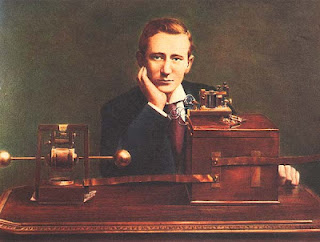
I found this interview with Guglielmo Marconi in Leslie Baily’s BBC Scrapbooks. It was conducted in 1896 shortly after Marconi had installed a transmitter on the roof of the GPO and a receiver in a building on the Thames Embankment, 500 yards away.
“Was the message quite clearly received?” asked the American reporter.
“Quite clearly.”
“And do these waves really pass through things?”
“I am forced to believe the waves will penetrate anything and everything.”
“Won’t fog prevent them?”
“No, sir, nothing prevents them.”
“Do you mean to say, Mr Marconi, that I could send my report of this interview from London to New York?”
“Please remember wireless is a new field. With regard to the future, so far as I can see it does not present any impossibilities to signal to New York.”
Wire-less communication. One of the most important inventions of the past 100+ years?


 Sound Of The Hound