The strong legacy of EMI is a testament to the people who worked for the company and those who loved the music across the years. We’d love to hear from those who have worked for EMI and from those who have enjoyed the music from outside of the company. What music they love? Which artists they adore? What shows they saw? And any other memories of the music that came out of EMI.
We’d love to see your pictures and learn who is in the photo and what is going on? As well as video’s of your favourite songs from across the years.
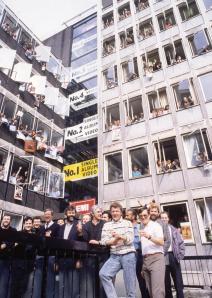
Staff from the EMI Archive Trust sat down with a previous EMI executive, Rupert Perry, to talk about a photograph when EMI staff were celebrating achieving the No. 1 Single, No.1 Album and No.1 Video at the EMI Records Manchester Square building in 1987. (Image courtesy of the Rupert Perry Collection.)
No. 1 Single, No.1 Album and No.1 Video at the EMI Records Manchester Square building in 1987
Take a look at a blog post of his thoughts via this link.
If you have any of your own #memoriesofEMI stories to share please get in touch!
The NOW that’s what I call music CD compilation album is 30 years old today.
The most successful/best selling of the NOW series was NOW 44 millennium edition in 1999 which sold 2.3 million copies and was released in November instead of the usual December release.
Can you guess which artist has the most tracks on the NOW albums?
It’s the one and only Robbie Williams!
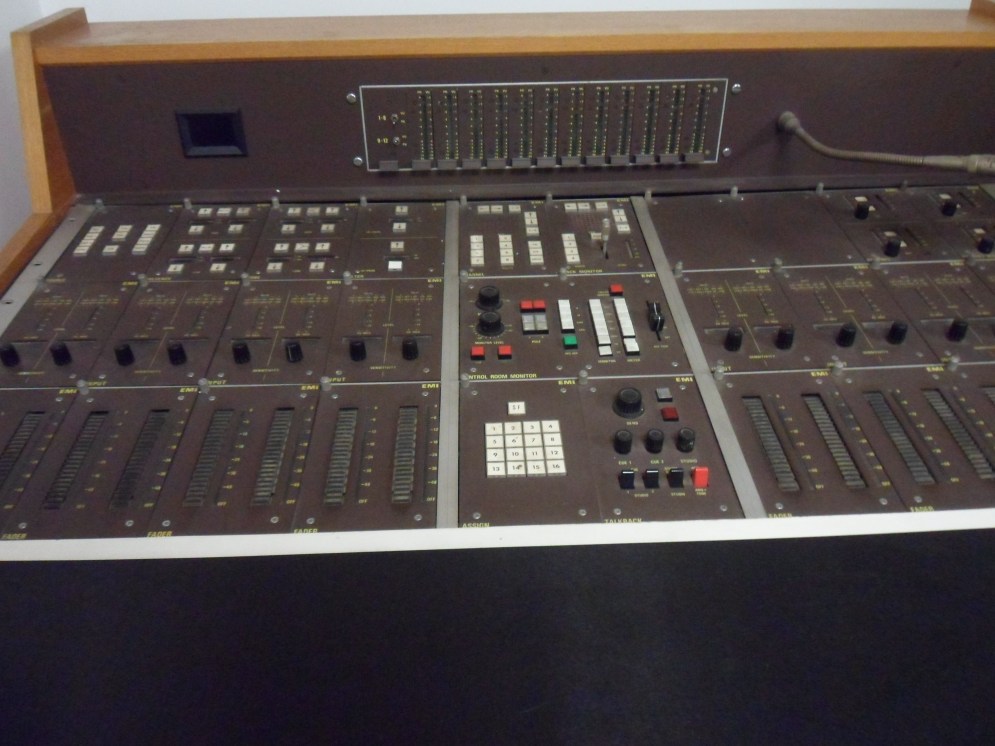
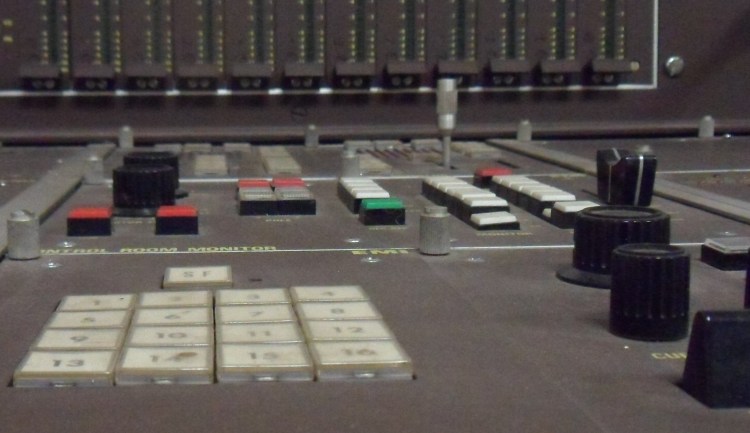
This is an experimental Digital Desk from around 1980. This is the work surface and there were also 3 full sized racks of machinery to do all the processing. It was built by EMI’s Central Research Laboratories. Read this extract from the Audio Engineering Society to find out more.
50 years of Dr Who this week!
Delia Derbyshire was the lady behind the Dr Who timeless sound track.
Read more about her life, her work and her creative flair here.
Deep in the vaults of the EMI Archive lies a mysterious Ghostly Gramophone player. Despite laying dormant for many years, while showing visitors around the collection an unsuspecting intern and her guests witnessed the turn table revolving. The gramophone in question in not electric, no one had touched it and the winding mechanism is frozen.
We have video footage of the guests looking curiously at the turn table as the turn table continues to turn unassisted!
Is this paranormal activity or do you have a more scientific explanation?
Special thanks to Danielle Burgess, Kevin Bell and Dev Ruprai.
“Fred was clearly one of those Children with a natural talent for the keyboard, and his mother made the most of this opportunity from the moment she began to teach him when he was four.”
-Extract from ‘A Voice in Time’ – Jerrold Northrop Moore
Name: Frederick William Gaisberg
Born: 1 January 1873
Resident: Born in Washington DC, immigrated to the United Kingdom as a young man of only 25 in 1898
Fred Gaisberg’s love affair with music began at the early age of just four. From the age of eight until his voice broke Fred was a chorister at St John’s Episcopal Church, here he met and studied under one of Washington’s most celebrated artists of the time – the young master of the United States Marine Band, John Philip Sousa.
“I attended rehearsals in his then modest home in the Navy Yard in South Washington. He (Sousa) patted me on the head and made quite a pet of me… I was one of those music-mad youngsters who hovered by his podium and never missed a concert.”
-Fred Gaisberg recalling his childhood
Although he was an excellent singer, the piano remained his first love and after securing a scholarship to study piano he gained a reputation for his excellent playing and accompanying and was soon playing for charitable organisations and amateur organisation throughout the city. In 1889 in search of some more pocket money, the sixteen year old Gaisberg came across an advert for the Columbia Phonograph Company. They were looking for someone to play the piano loudly and clearly enough for its sounds to be captured by the apparatus as the accompaniment for a musician to record.
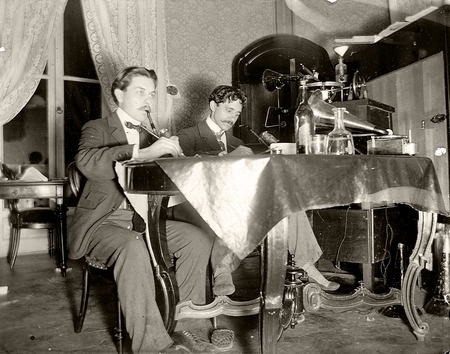
One of the first musicians selected to record with Gaisberg was John York Atlee, a Whistler. Together they would churn out in three’s countless records of performances of ‘Whistling Coon’, ‘Mocking Bird’, and the ‘Laughing Song’. These recordings were made on small hollow cylinders of wax, where a needle moved gradually in a lateral way etching the grooves that represented the sound waves into the wax.
Fred Gaisberg secured his first job working at the Columbia Phonograph Company. He spent the next few years working for various people within the growing phonograph industry, including Thomas Edison.
In 1894 he met Emile Berliner and his career took on a new direction. His fascination with Berliner’s novel recording process was the start of his career change from an accompanying pianist to a recording sound engineer. Very soon after meeting and working under Berliner, Gaisberg was sent to London to record music for the European market, working with Trevor Lloyd Williams and William Barry Owen.
Once he reached London he was introduced to another sound engineer – Sinkler Derby and together they continued to travel all over the world recording local music for the ever expanding Gramophone Company. His travels are well documented in “The Fred Gaisberg Diaries” which have been made available by Hugo Strötbaum. Fred Gaisberg was without a doubt one of the single biggest contributors to the success of the Gramophone Company. More details on exactly what he got up to can be found in our Gaisberg Travels blog series.

 Sound Of The Hound