The Eldridge Johnson Story: Bringing Music To The People!

By Carey Fleiner

In 1984, Eldridge Reeves Johnson received a Grammy Award.This posthumous Grammy, The Trustee Award, was presented to Johnson in recognition of his services to the industry; the inscription reads, ‘Eldridge R Johnson: Industry pioneer whose inventions revealed the true potential of the early Victrola as a home entertainer rather than a scientific toy.’ While in this entry, I’d like to focus on the significance of the inscription, here’s first two bits of trivia: one, the machine that has sat on top of every Grammy since their inception in 1959 is in fact modeled after Johnson’s original improved gramophone. Two, the little machine is not a Victrola, which was a very specific type of Victor machine – but the use of the word shows Johnson’s success as an advertising man.
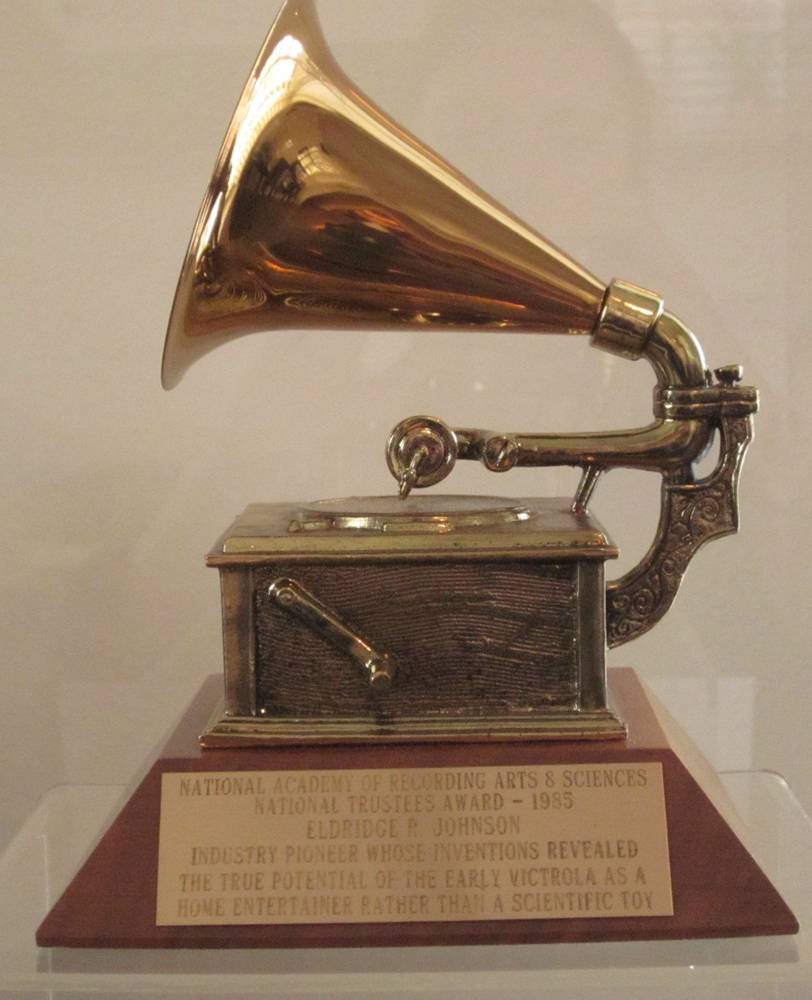
ERJ’s Grammy award, housed at the Johnson Victrola Museum, Dover, Delaware, USA (author’s photo)

Berliner in the States and the Gramophone Company in the UK saw the potential of the gramophone as a source of entertainment, and Johnson refined this concept. His mission was to promote Victor and its products towards home entertainment, bringing culture and enlightenment to the masses. In the early days of recorded sound, inventors such as Eduard de Martinville, the Bells, and Edison were more interested in the scientific principles behind or business uses of the machines. Outside of toys and the jukeboxes in workmen’s clubs, entertaining the proles was very low on Edison’s, and other inventors,’ list of priorities, and subsequently not taken seriously.
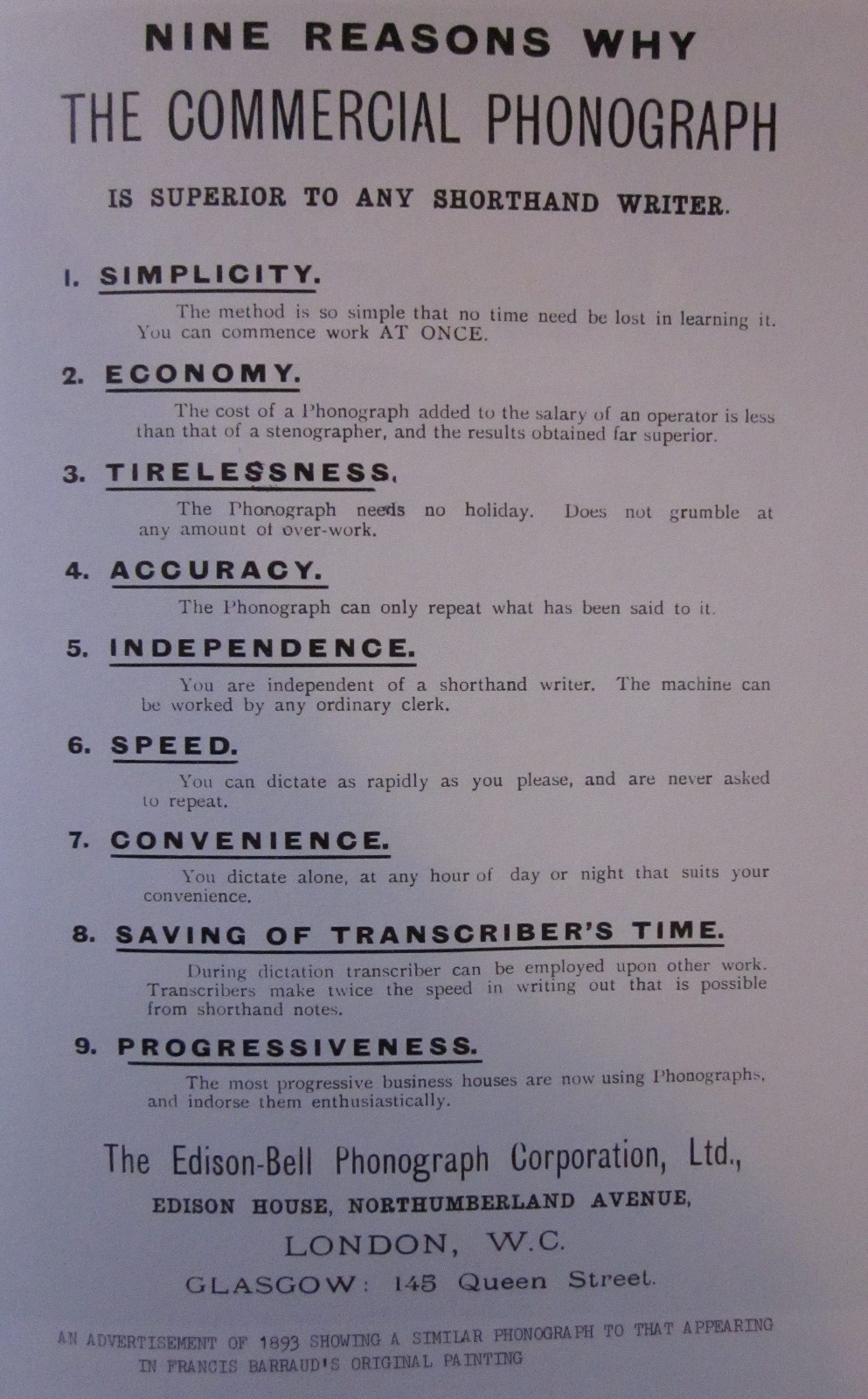
Edison’s list of the possible uses for talking machines

Many advertisements, especially those aimed at a male audience, touted the technological achievement and capabilities (or sometimes, rather exaggerated capabilities) of the machines.
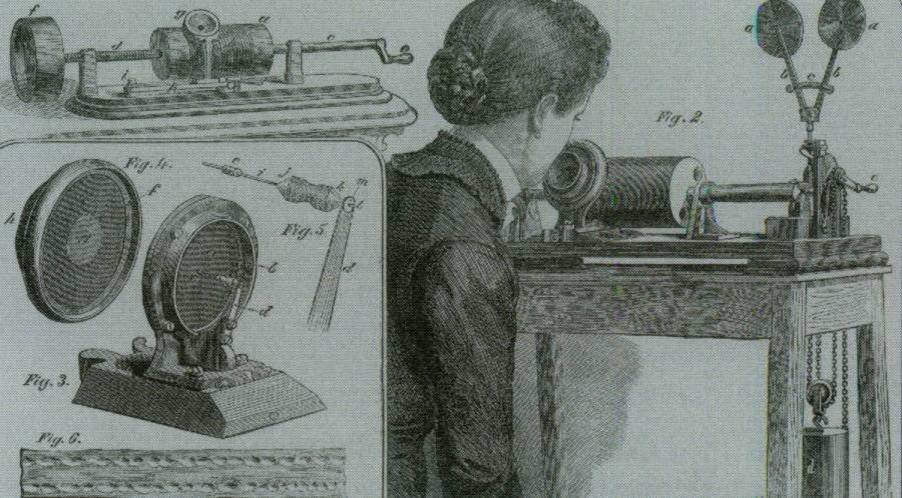
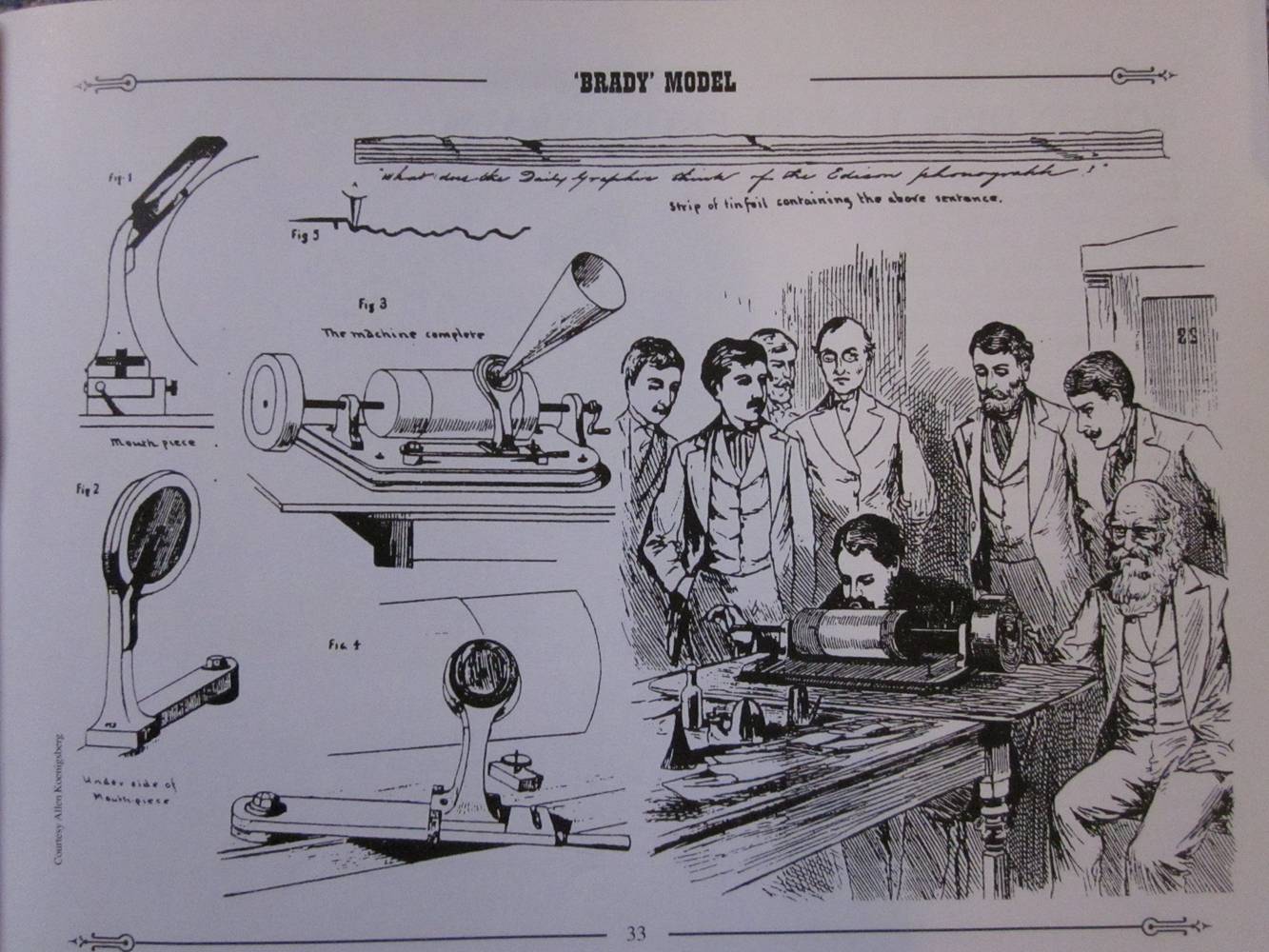
The earliest advertisement for a tin foil machine
Not only were recording machines regarded as toys, their poor playback capabilities ensured that their novelty value wore out fast – and because the early recording machines were so primitive, ‘serious musicians’ would not make recordings as they felt the limitations of the machines and records were an affront to their art. The spring-loaded motor Johnson added to the gramophone changed all of this
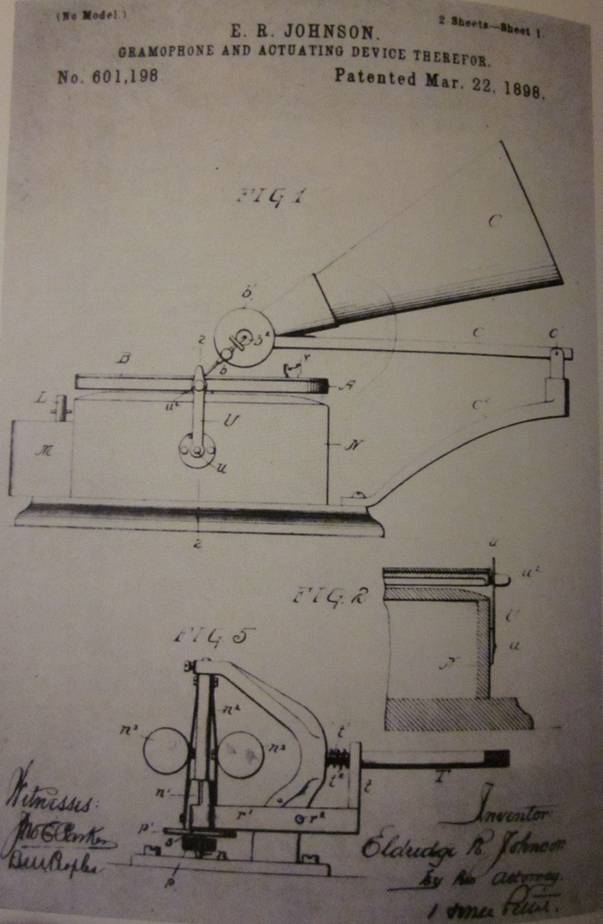
The patent diagram for Johnson’s spring-loaded clockwork motor built for Berliner

It was the first of a number of inventions by Johnson to improve the recording and playback capabilities of his machines culminating with the orthophonic Victor models in the late 1920s.
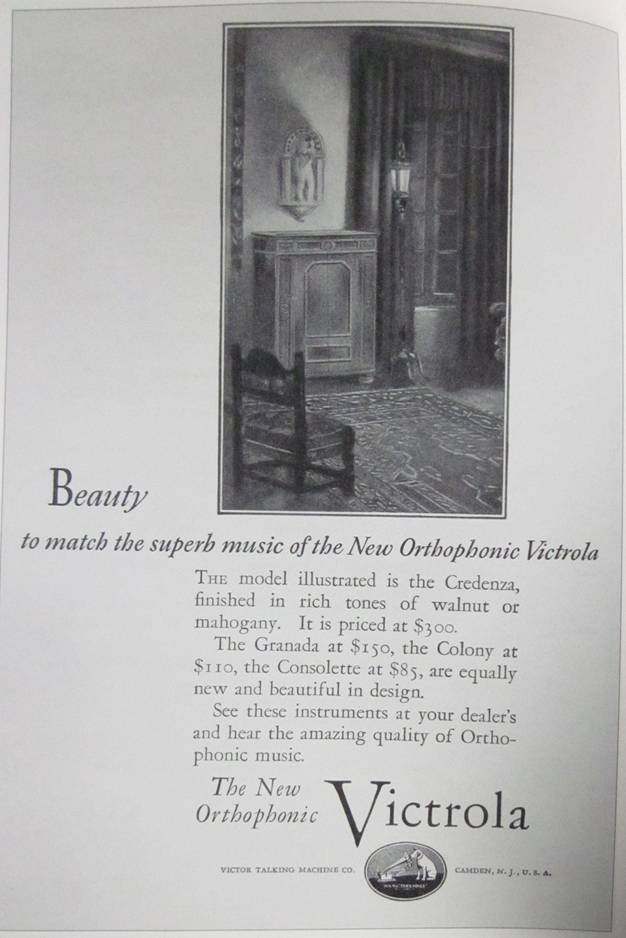
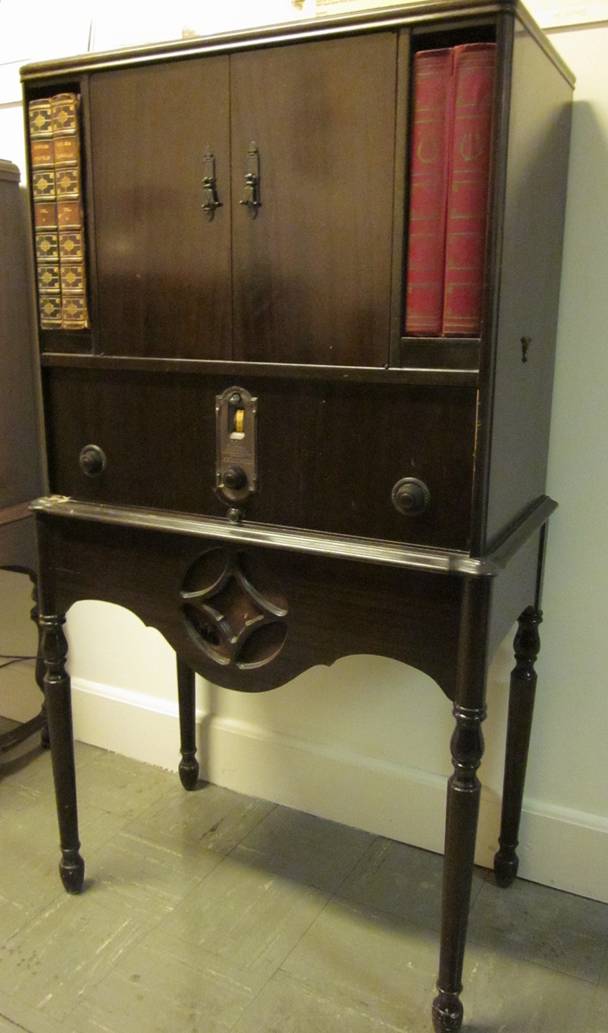
The orthophonic machines were quite loud and frequently used in dancehalls

These machines were still hand-cranked, but the records themselves were recorded on electrically-driven machines, vastly improving the playback sound.

Unlike his peers, Johnson did not regard home entertainment as vulgar; in fact, he saw it as an extension of his own desire to become cultured and self-educated.
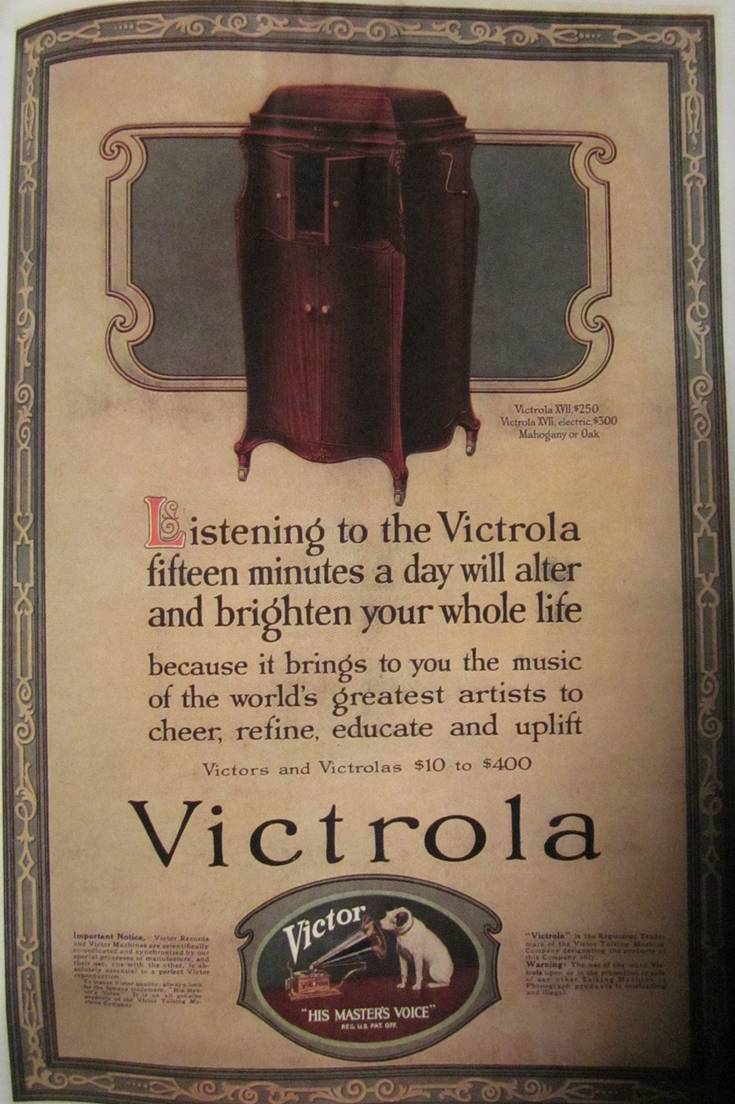
Victor machines were deliberately priced across a wide range so that they were just as affordable as they were beautiful. They ranged in price from $25 to thousands of dollars; in 1901, the average weekly take home pay in a working-class family was $2.50 per week (based on data from the 1900 US census); nevertheless, Victor was in the black from the beginning – even the cheapest machines were within reach, because Victor was one of the first companies in the United States to allow purchase on credit. Johnson figured every household could spare a few pennies every week towards a player, and of course, every week when they went to the furniture store or record shop to pay towards their machine, they might also be tempted to buy a new Although Victor had started out simply making machines, they got into the recording business pretty early, and these records were promoted to bring art, culture, and entertainment into anyone’s home. Victor advertising, especially in women’s magazines, emphasised this. Johnson also had a good ear for potential artists in Victor’s stable – not only adding popular artists of the day such as Billy Murray:

and Ada Jones:

They also frequently sang duets together for Victor:
Victor concentrated especially upon recording classical singers and musicians. Fred Gaisberg had already enticed Enrico Caruso to sing for the Gramophone Company in England – this was a huge coup for the nascent recording industry, as opera singers in the late 19th and early 20th centuries were the celebrity royalty of the day, traveling in upper class circles and living literally in palaces along the Riviera.
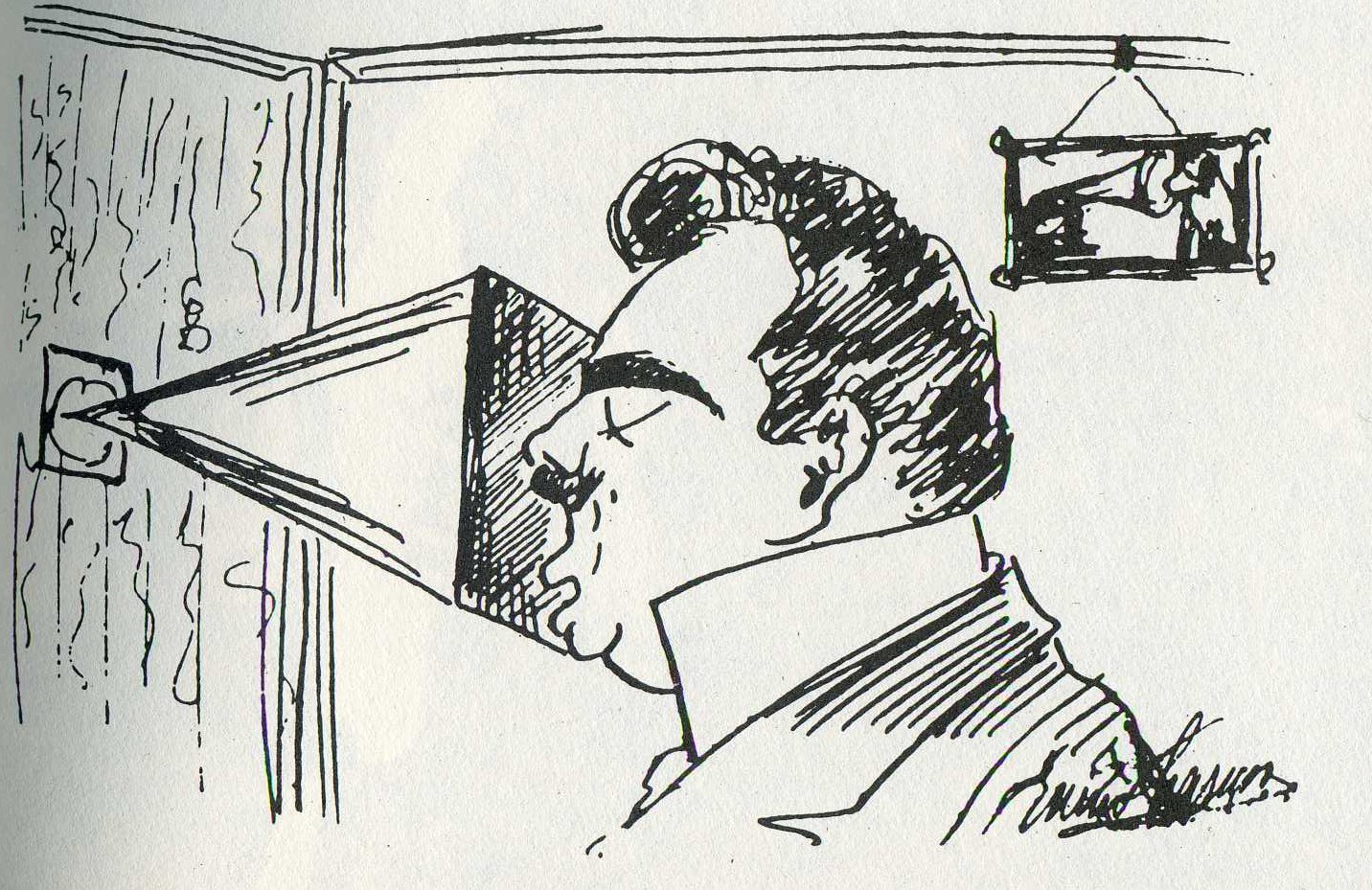
Caruso’s first recording session as sketched by the man himself

Victor and the Gramophone were fiercely in competition with one another, and once Caruso began to record both popular and classical music for Gaisberg and then Victor many others followed suit.

These included Nellie Melba:
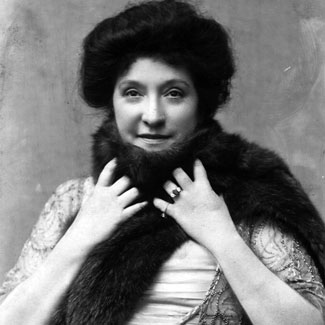
and Luisa Tetrazzini
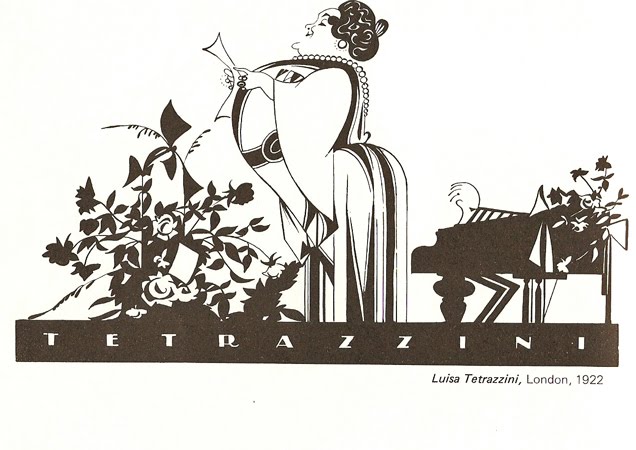
All of the big names were on Victor, and Victor cleaned up by signing these stars to exclusive contracts.
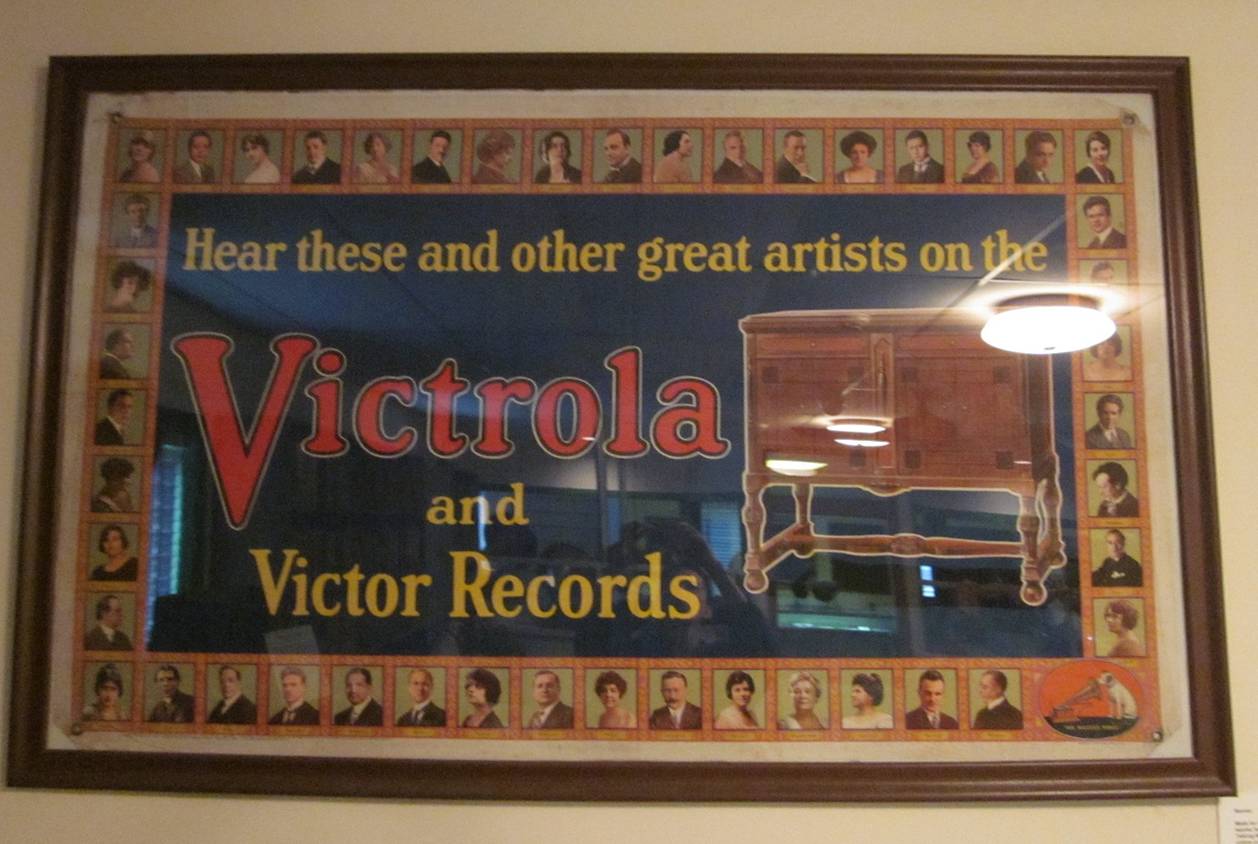
An advertisement showing Victor’s stable of stars

To emphasize the distinction of Victor’s classical line, they introduced a red label for their opera and classical music stars
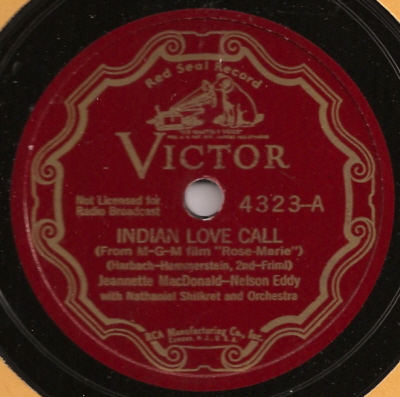
– except for Dame Melba, who demanded, and received, an exclusive mauve label.
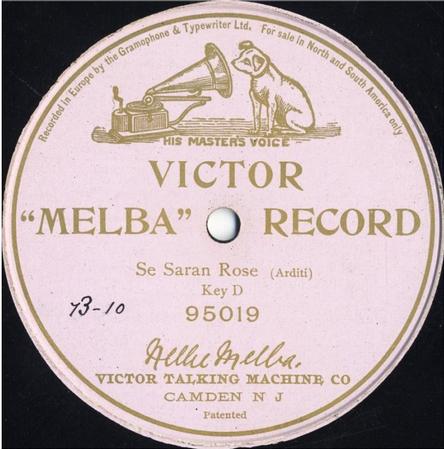
Melba Mauve — one of Dame Nellie’s pink records
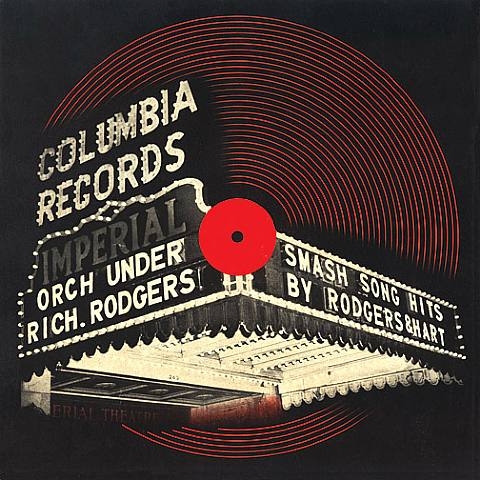
Art you can dance to. How the record sleeve was turned into something beautiful.

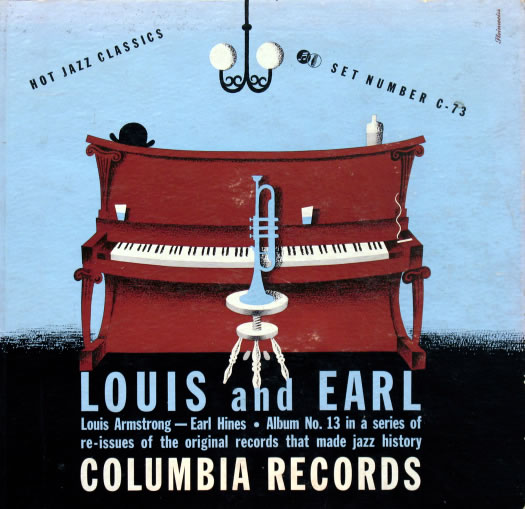
It seems quite remarkable that it took until 1939 for the music industry to take advantage of the natural advertising real estate of the record sleeve. Until that point record sleeves were plain and drab. In 1939, Columbia Records in New York hired a young 23-year-old to become art director of the company. His name was Alex Steinweiss and he was given the job of creating ad’s for Columbia’s latest recordings.

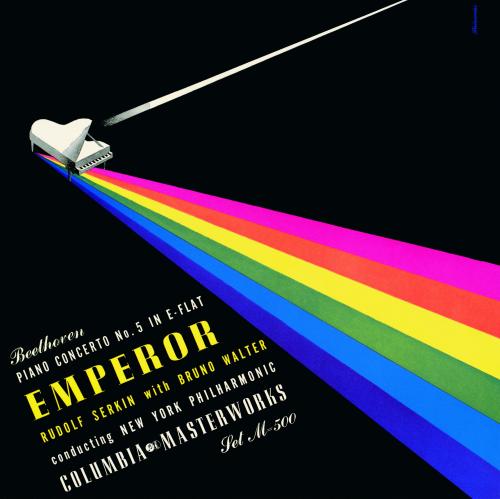
Never mind the adverts, Steinweiss thought the products themselves needed improving. “The way records were sold was ridiculous,” he said in a later interview. “The covers were brown, tan or green paper. They were not attractive, and lacked sales appeal.” He persuaded the suits to let him loose to design something more attractive. This was his first attempt, not bad, huh!

Steinweiss went on to design over 2,500 record sleeves in his career which extended into the 1970’s, including these ones:

Perhaps a hint of Dark Side Of The Moon?

He set in motion the notion the record sleeves were the perfect home for 12″ x 12″ pieces of art and design. All those wonderful images of swimming Nirvana Babies, Sgt Peppers, Yellow bananas, bulging trouser zips and  light diffracting through a prism started from here, with this man’s great idea.

Sadly Alex Steinweiss died at the weekend, aged 94. He left behind a collection of wonderful images both on record sleeves and beyond. You can learn more about him in this wonderful little video:

The Paris Match: Gaisberg and Clarke make discs and cylinders side by side in 1899

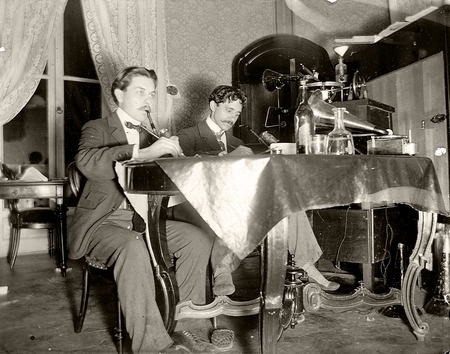
Gaisberg’s first continental recording trip with William Sinkler Darby had begun in Leipzig in May 1899, where Thomas Birnbaum the Managing Director of the German Gramophone Company, joined them to travel to Budapest, Vienna and ultimately the dazzling musical city of Milan. The trip had been a mixed bag; lots of fun, some successses but Gaisberg ultimately left Italy a mite down-hearted at his failure to record any significant artists during their stay in Milan.

Gaisberg (right) and Sinkler Darby (with pipe) share a bottle of wine and write letters home from their hotel room in Vienna that doubled as their studio

Their next stop was Paris. This was where the thrusting Alfred Clark was building a highly successful recording operation. He leveraged his growing local power to deliver a series of great artists to Gaisberg’s recording sessions. Fred later recalled: “Alfred Clarke had all the vision of youthful enthusiasm, and it was not long before he had enticed to his recording studio the great stars of opera and concert halls”

It was also here that Gaisberg remembered making records with Clarke’s assistant so that they would fit both Edison’s cylinder and Berliner’s rival disc: “I recorded the first discs in Paris in 1899 under Alfred Clark’s direction. Cleve Walcott, his assistant, would record simultaneously the same artists on cylinders, as he [Clark] was then building up both a cylinder and disc catalogue….” This explains how Clark managed to reconcile the recording format wars and service both the cylinder and disc part of his Paris based business.

The History of the Major Record Companies in the UK #3 Pathe Freres

This is the third extract from a wonderful book called “The Talking Machine Industry” written by Ogilvie Mitchell in 1924 covering the Pathe Freres Company.

Charles Pathe

Emile Pathe

Charles and Emile Pathe originally ran a bistro in Paris. They moved into music retailing, first selling Edison products before beginning to record and sell their own records. They also moved into film making and distribution and expanded both sides of the entertainment business into wider Europe and the USA. In 1924, when this book was published, Pathe were hitting financial difficulties and, four years later, the French and British Pathé phonograph assets were sold to the British Columbia Graphophone Company which would in turn soon become part of EMI. In July 1929, the assets of the American Pathé record company were merged into the newly formed American Record Corporation.

This is what Ogilvie Mitchell had to say in 1924:

“Pathe Freres, who had been doing a very large continental trade, came into the English market in 1902. By the exercise of a little ingenuity, aided by Mr. J. E. Hough, they had previously circumvented the Edison embargo. No sooner, however, were they free to export their goods from France to England than they began to do an extensive trade with us. The Pathe discs are phono-cut, i.e. they are of the hill and dale variety invented by Edison, and therefore require to be played with a special needle. To this end the firm supplies asound box of its own with a permanent attachment of a ball-pointed sapphire. Quite recently it has brought out a reproducer which by a simple contrivance permits of a steel needle to be used for the lateral cut disc as well.

In the early days Pathe records were played from the centre outward to the periphery of the disc, but since the company erected a British factory on this side the Channel they have reversed their old system and the record is now played in the same manner as other discs. Those old discs were splendid fellows, nearly 14 ins. across and embodied the voices of many of the best continental artists. The firm actually prevailed upon Sara Bernhardt to record her incomparable tones, and in the years to come that disc ought to be worth much more than its weight in gold. The records are now somewhat reduced in size, conforming more to the width of ordinary makes, but the best of them at the present time are the most expensive on sale in England.

It is worthy of mention that Pathe Freres were the first to introduce the language-teaching record, and it is quite possible that they may revert to this very useful method of instruction now that there is a demand for easy systems of learning foreign tongues.

Besides building a factory here in England, Messrs. Pathe” have established a large business in America, which we understand is extremely prosperous. M. Jacques Pathe is at the head of affairs in London, and is a shrewd and competent director. He fought in the war for his country and received high commendation for his service. Although it has nothing to do with this little book it may not be out of place to state that Pathe Freres are a firm with very extensive interests in the kinematograph world. The House of Pathe, with its defiant chanticleer as a trade-mark has branches in every corner of the civilized globe, and its machines and discs are familiar to everyone who has the slightest knowledge of the reproduction of sound.”

Victor Ludorum. The Forgotten Man of Music History: Eldridge R.Johnson

By Carey Fleiner

Quick – show of hands – tell me everything you know about Eldridge R. Johnson….well, if you’re poking around this website, you probably have heard of him, but many people have not. If you’re one of the ‘nots’ — perhaps you’ve heard of his company The Victor Talking Machine Company which he founded 1901 (or at least its later incarnation as RCA-Victor). Perhaps you’ve heard of the Victrola, and in fact you might refer to every type of old-fashioned, wind-up record player as a Victrola. And surely you’ve seen Nipper the Dog, one of the first and most successful trademarks in business and advertising history. But this guy with the funny name and that – what’s he got to do with talking machines, fox terriers, and, for that matter, EMI?

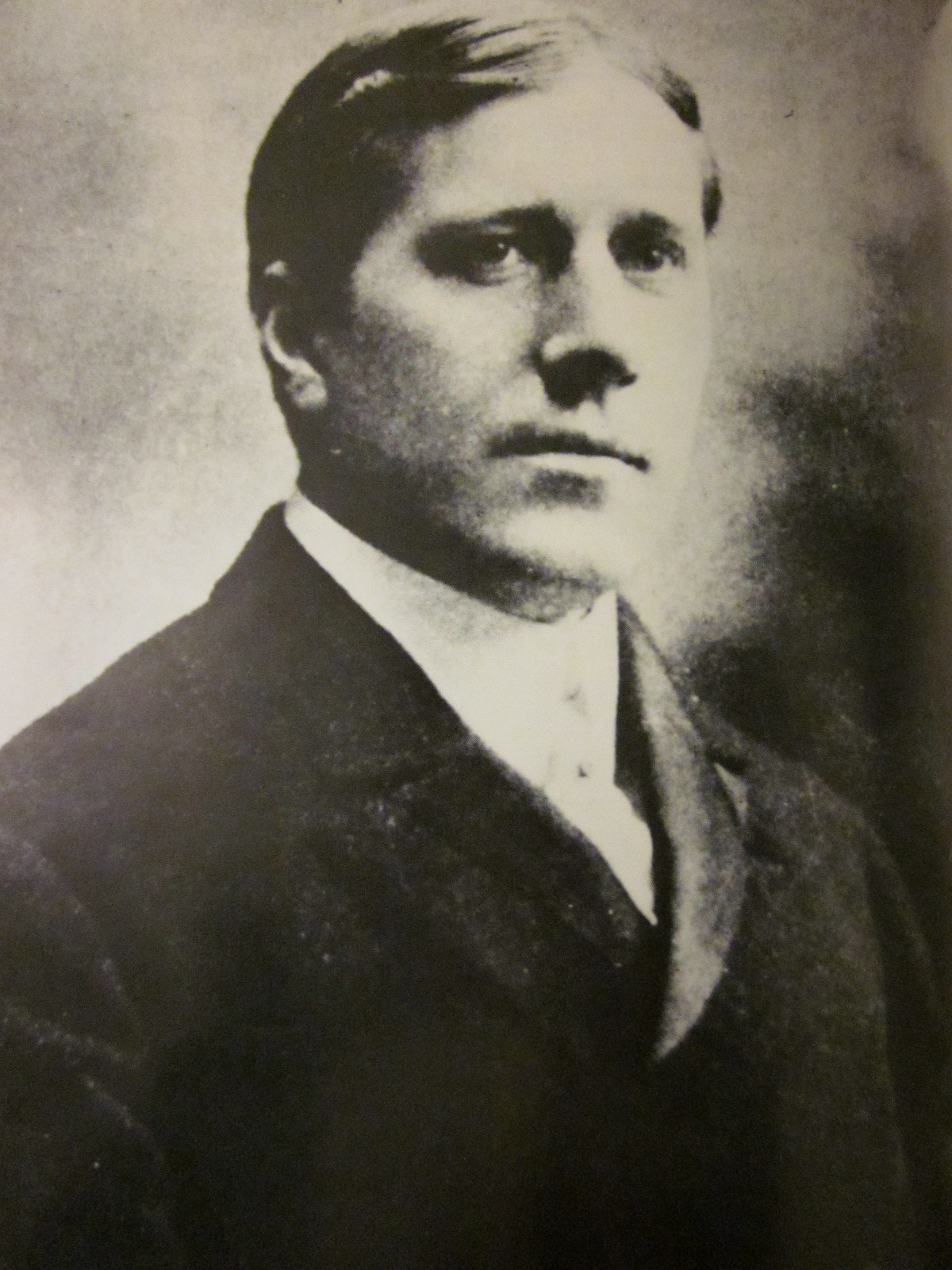
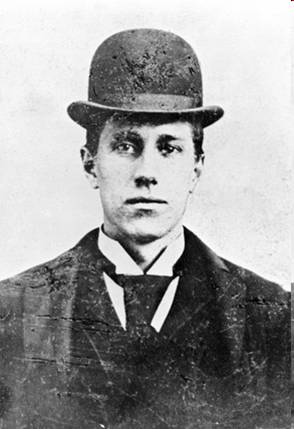
Eldridge R Johnson around age 35

Eldridge Reeves Johnson (1867-1945) is an obscure figure in music history, and his name is certainly not as recognisable as Thomas Edison or Alexander Graham Bell. It’s a bit of his own fault, really, as Johnson, while promoting his company and its products vigorously, himself stayed in the background – unlike his contemporary Edison, or modern moguls such as Bill Gates or Richard Branston, whose names are as well-known as their products. Nevertheless, Johnson founded one of the ‘Big Three’ early record companies – The Victor Talking Machine Company (1901-1927) held its own against Edison Records (1888-1929) and Columbia Records (1888-present). The Victor Company was a sister-company with the Gramophone Company (independent from 1897-1931) in the UK; the Gramophone Company merged with the Columbia Graphophone Company in 1931 to become EMI, so Johnson and the Victor Talking Machine Company are part of EMI’s pedigree.

Over ten instalments, we shall present 10 Interesting Facts about Eldridge R. Johnson, one of the founders of the modern recording industry. Before Johnson Fact #1, however, here’s a little background on the man himself.

Johnson was born in 1867 in Wilmington, Delaware, USA, and grew up about 60 miles further south in Dover, Delaware, then a rural community. He went to high school at the Dover Academy in Dover, Delaware, now part of the grounds of Wesley College [http://www.wesley.edu/], and he hoped to go to university. It’s unknown which school or course of study he had in mind; when Johnson, then aged 15, approached his high school principal about going on to higher education, he was told he was ‘too stupid’ to attend university, and should go to trade school instead.

ERJ in the 1890s

Johnson was gutted, and this comment stuck with and influenced him the rest of his personal and professional life. He was put on a train and sent north to be apprenticed to a machine shop in Philadelphia, and, according to the biography written by his son, ERJ cried all the way to his destination.

Was Johnson ‘too stupid’? As a boy, he asked a lot of questions – at home and at school. Nowadays this is regarded as the sign of an inquisitive mind, praised, and encouraged, but in those days, asking so many questions was interpreted as being daft.

Nevertheless, despite the low pay and long hours initially, Johnson applied himself to the work and his apprentice job, and to his displeasure (initially) he turned out to be quite mechanically apt. He worked in Philadelphia, then became attached to the Standard Machine Shop in Camden, New Jersey (where he filed his first patent to improve a bookbinding machine at the shop – Johnson seems to have been that guy who shows up in a place and quickly fixes all of the mechanical problems plaguing the company). At one point he went West to seek his fortune as the owner of this new shop planned to leave the business to his own son, but after a few adventures, Johnson realised there was more opportunity for work back on the East Coast. He returned to the little shop in Camden and inherited it after all, as the son had died suddenly and the owner was in financial peril. So Johnson took over the little shop and began to build a reputation for himself in the area as a mechanical engineer. Although he devoted himself to his work, he was also driven to educate himself in the classics and refined arts, and his diaries reveal later trips to the opera, visits to museums, and lists of literary texts to read. He never stopped asking questions, and turned his inquisitiveness into a business success – whether he was asking his workers about their lives and working conditions, or his customers about suggestions they had about or wanted from his products.

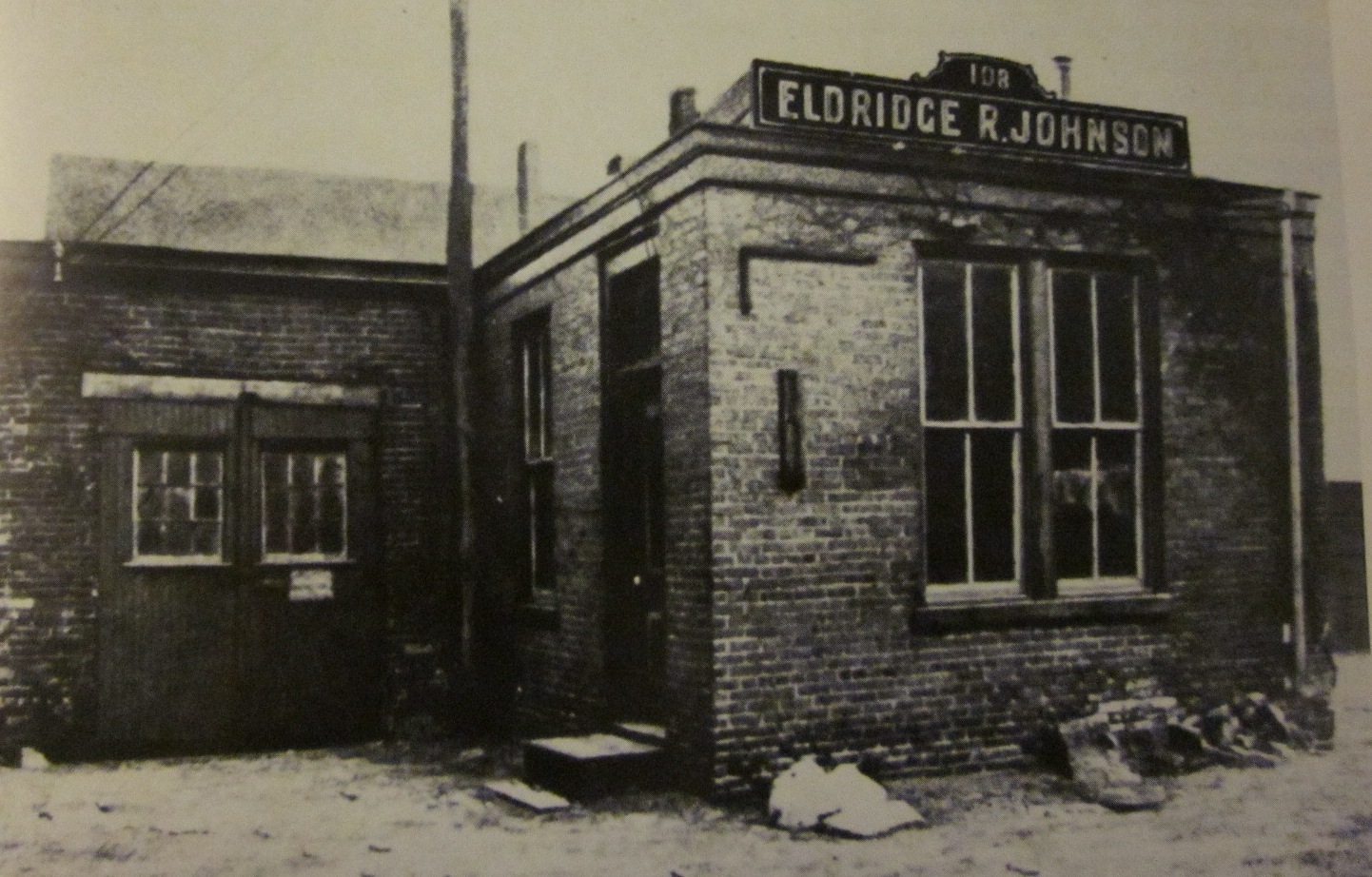
This same, small machine should would eventually be surrounded by the Victor Talking Machine factory complex.

Johnson’s shop in Camden in the 1890s

In 1896, a representative from Emile Berliner’s Gramophone Company brought to Johnson’s shop one of Berliner’s ‘egg-beater’ or hand-driven gramophones.

Berliner’s original eggbeater gramophone

Berliner had patented his gramophone in 1887, but he himself was no mechanic – he wanted a spring-loaded motor for the machine to make it fully automatic, more than just a toy, as this would give him the edge in the extremely competitive world of sound-recording. Learning of Johnson’s mechanical skills, he sent the machine to the workshop in Camden. Johnson gave the little gramophone a look over, and took on the job – adding a spring-loaded motor (of his own design) would be quite easy.

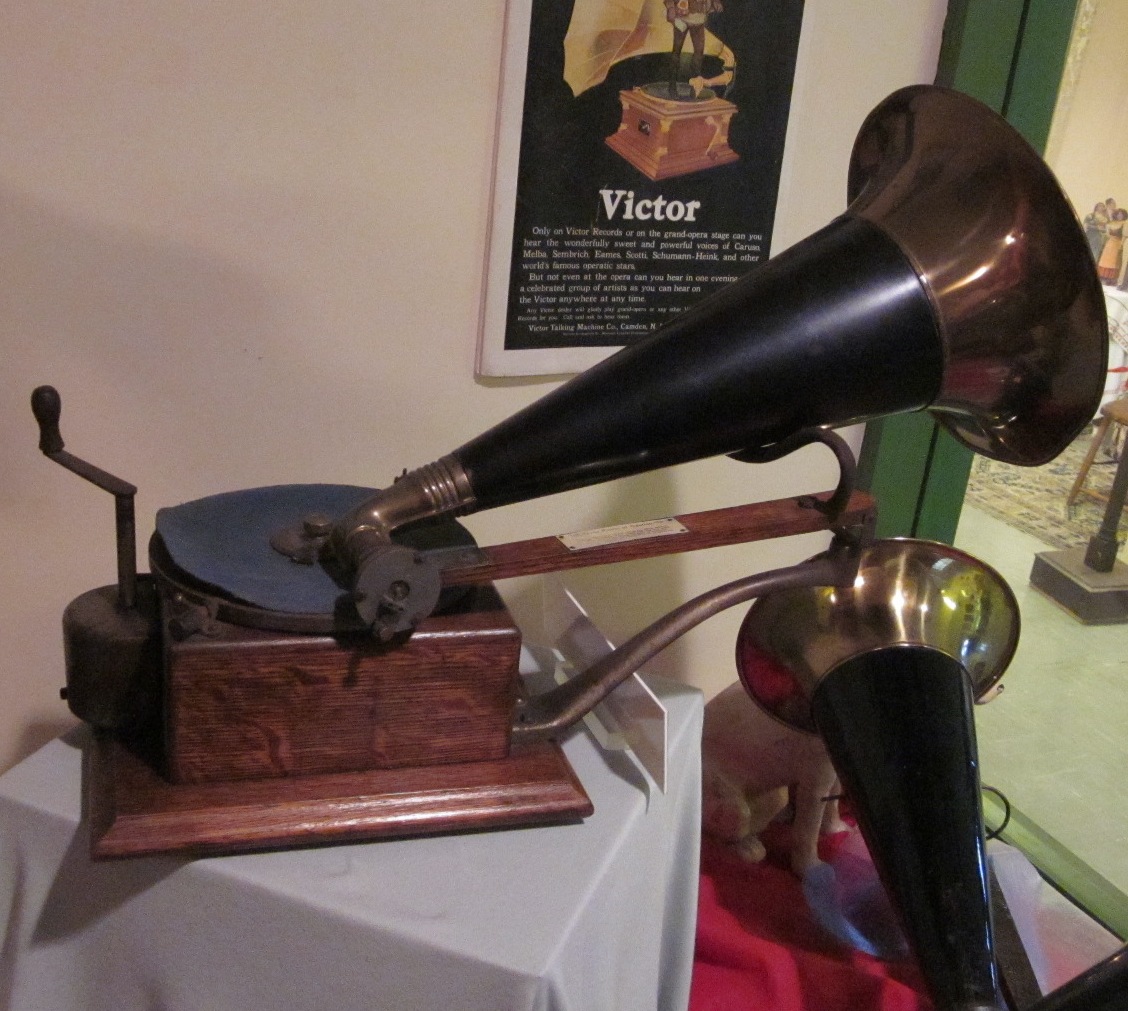
Berliner gramophone with Johnson’s spring-motor

Here are two clips of Berliner’s original gramophone in action: the egg-beater in action and Johnson’s added motor:


…and another short clip (in French) showing the eggbeater, then the improved gramophone, with a shot of Johnson’s clockwork motor with the cover off:

This invention alone would have sufficed to ensure Johnson’s role in the history of the recording industry: not only did this motor free the user from having to hand-crank the machine, but it also standardised the recording speed at about 78 rpm – instead of a toy, the gramophone could be regarded as a proper tool for recording and promoting both popular and classical music and artists.

Of course that was to come – Johnson’s initial impression of that first gramophone was less than enthusiastic; he famously said that the sounded like “a partially educated parrot with a sore throat and a cold in the head.”’ Nevertheless, Johnson was intrigued and went into a subcontractor partnership with Berliner, building gramophones and gramophone parts. He also improved the quality of the recording process on the gramophone by experimenting with electroplating wax disks to make more precise and sturdier master matrices – the wax of which, by the way, came from melted down wax cylinders made by rival Edison.

This partnership also meant that he also entered into association and later partnership with Berliner’s UK component, The Gramophone Company (headed at that time by William Owen).

William Owen, head of the Gramophone Company around 1900

Almost at once he was embroiled in the Byzantine politics of betrayal, backstabbing, and litigation involving Berliner’s company and a breakaway company called Zonophone (who were, in effect, attempting to pass a law forbidding Berliner to sell his own products.)

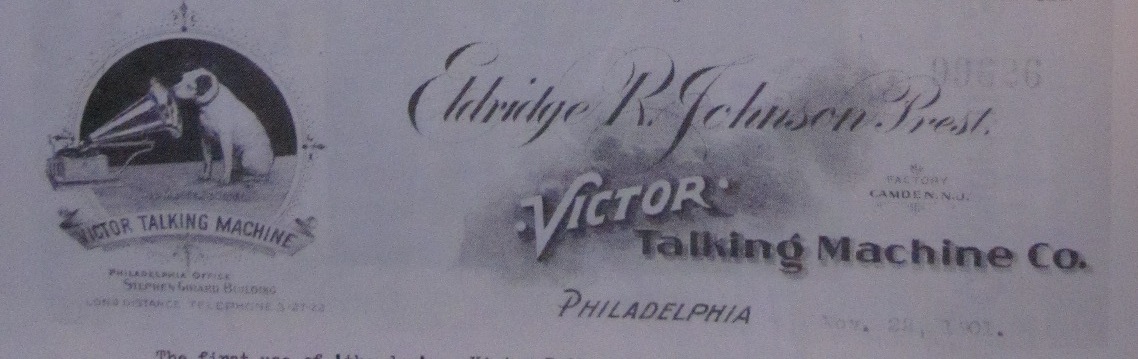
Long story short – Johnson won a successful lawsuit against Zonophone, saving Berliner, The Gramophone Company, and Johnson himself from financial ruin. Johnson’s original company, The Consolidated Talking Machine Company, became in 1901 The Victor Talking Machine Company, in cooperation and with the blessing of the Gramophone Company in England.

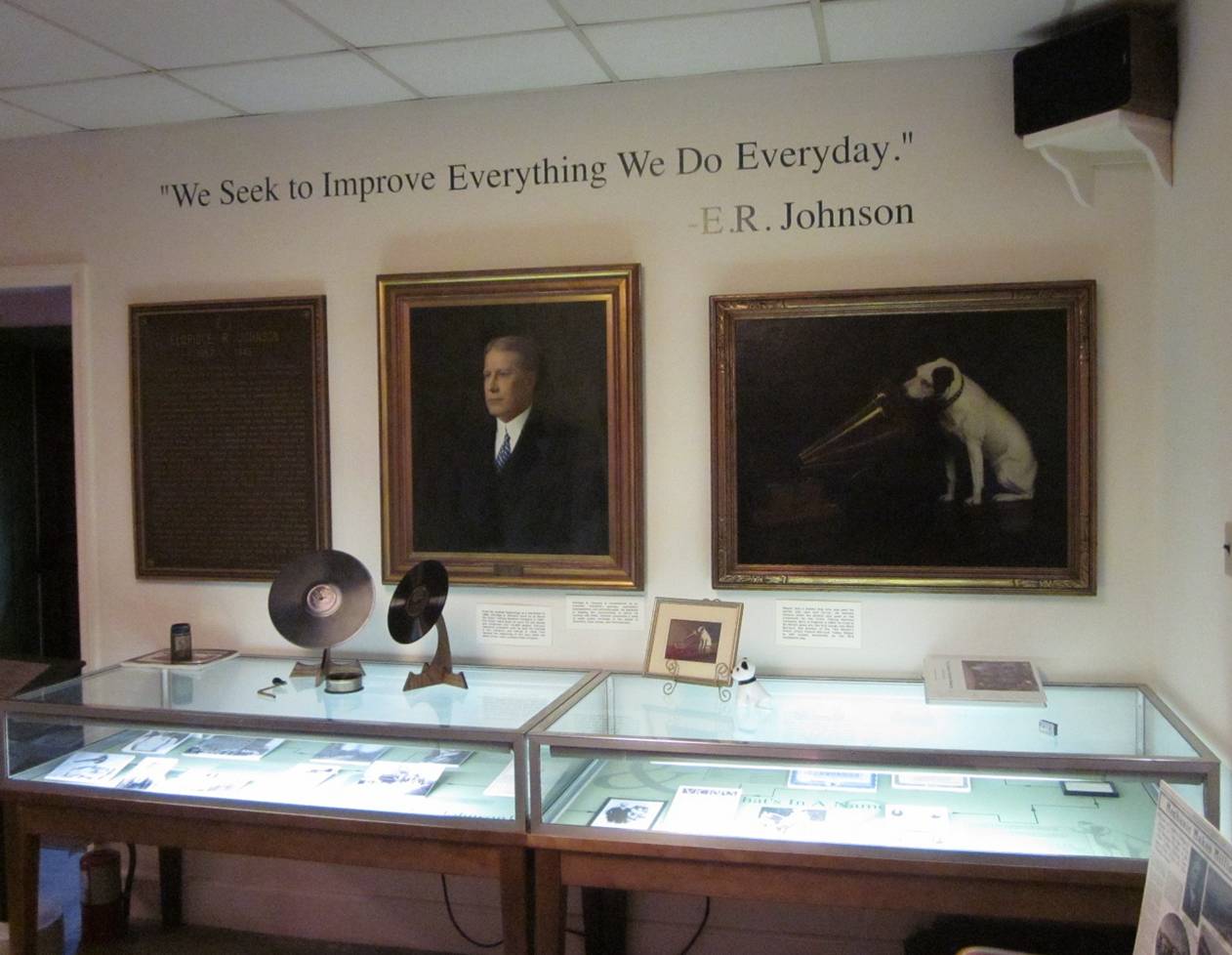
Between 1901 and 1927, Victor was one of the most successful businesses in the world. Johnson’s motto for the company was its ‘secret process,’ that is, ‘We seek to improve everything we do every day.’

Johnson’s motto serves as the mission statement at the Johnson Victrola Museum, Dover, Delaware, USA (author’s photo)

This motto reveals much about his own personality, drive for success, and care for his employees and customers. And because the company was his top priority, this motto provides a clue why we don’t associate Johnson with Victor as we might associate Nipper, the great singer Enrico Caruso, or the Victrola itself.

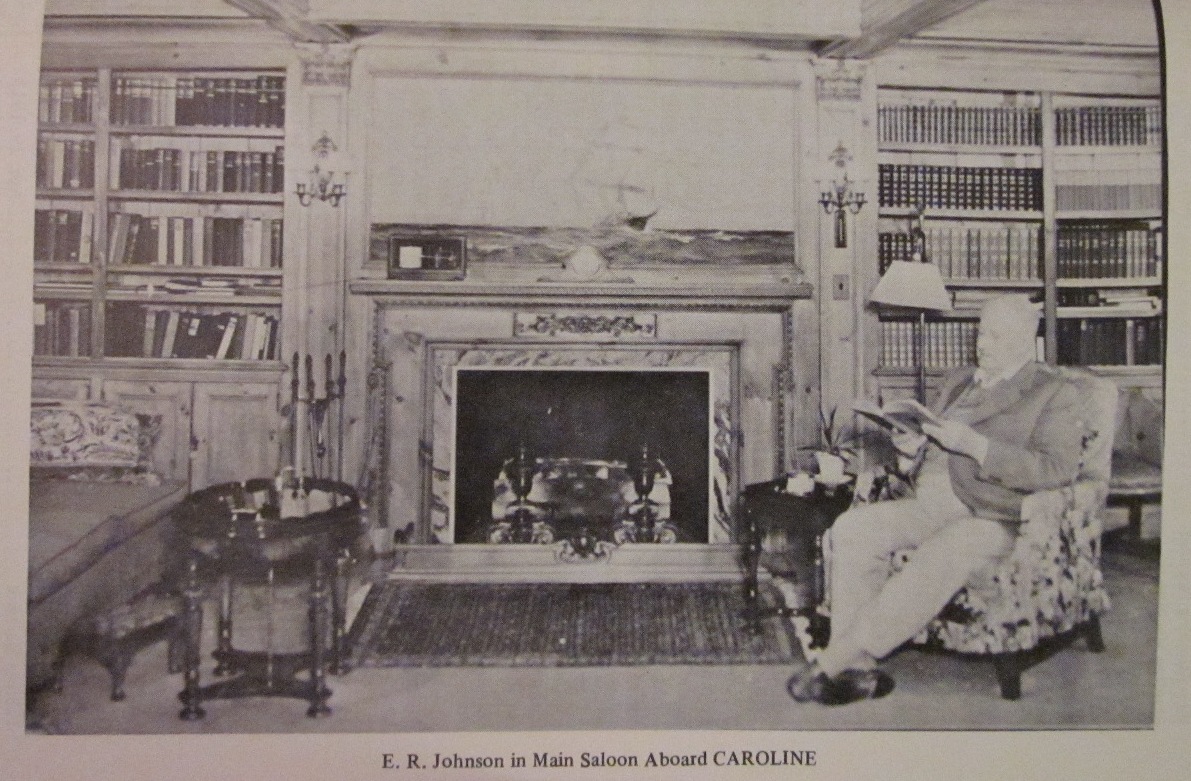
Johnson was a multi-millionaire very quickly with his company; when he finally sold Victor in 1927, he was worth close to $29 million. Problems with melancholia and depression had affected his relationship with his business over the years, and concerns that Victor was falling behind the competition with radio led him to sell his company 1927 (Victor was purchased by RCA in 1929), and he lived the rest of his life as a generous philanthropist while happily indulging his passion for his yacht and sailing. He died in 1945.

ERJ in his later years enjoying time on his yacht Caroline

Welcome to a new contributor

We are proud to welcome Carey Fleiner to the Sound Of The Hound team.

Carey is Assistant Professor at the University of Delaware. She teaches and writes widely about music. Her published work includes “‘History of Rock and Roll’ Courses: Bridging the Gap Between Reaction and Reality”, “Rebellion or Transformation: Dave Davies’ Spiritual Journey from the 60s to Present Day: A Contextual Analysis” and “Dulcet Tones: Changing a Gittern into a Citole.”

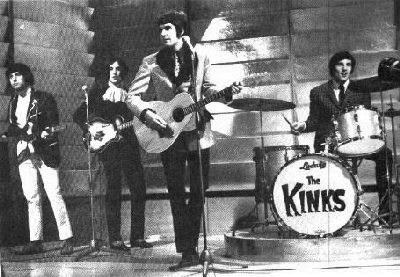
Recent public presentations include “Heroes and Villains: The Medieval ‘Guitarist’ in the Middle Ages and Modern Parallels”, “Innovation in 1960s Popular Music: Technology, Culture, and Politics,” and “Feminine Aspects in the Work and Performance of the Kinks 1963-1970.” She is a particular expert on The Kinks. All in all, none more SOTH!

Carey has written a series of articles about the great and now often over-looked Eldridge Johnson for SOTH, the first part of which is published tomorrow.

Welcome Carey.

Gaisberg’s first recording trip goes Pasta Milano. 1899.

Gaisberg and Sinkler Darby arrived in Milan from Vienna in July 1899. The musical city made a great impression on Gaisberg as he later recalled.

“My first visit to Milan..in 1899 was rich in experiences…I often saw Verdi (below) who would regularly take an afternoon drive in an open landau drawn by two horses. People would stand on the curb and raise their hands in salute as the carriages proceeded down the Via Manzoni to the Park. A frail, transparent wisp of a man, but the trim of his pure white beard so corresponded with the popular picture of him that one could not fail to identify him….

One could sit at the Cafe Biffi (below) in the Galleria and have pointed out to him Puccinni, LeonCavallo, Mascagni, Franchetti, Giordano, Tamagno…as they santered through the throng of chattering citizens on their way to to have their midday aperitif”.

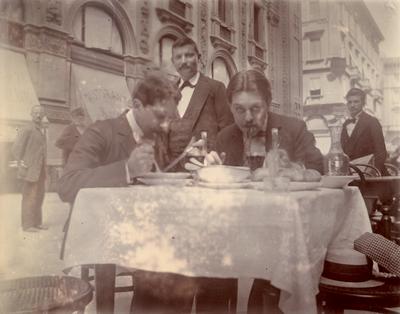
Gramophone Company agents were already operating in Italy. Alfred Michalis worked Milan and his brother William worked in Naples. They were building the company but unfortunately the promise of Milan and the Michaelis brothers proved greater than the reality. Almost 250 recordings were made in Milan but the artists were largely “nonentities.” The big stars were not yet interested in or possibly even aware of the new recorded medium. Despite loving the experience of the Italian city, Gaisberg left Milan a tad professionally disappointed in mid-July. Future trips would prove much more successful, including the recording of Caruso in 1902, but until then the memory of the wonderful Italian food would have to suffice. Here’s a photo of Gaisberg and colleague William Sinkler Darby enjoying some local nosebag! It looks like a scene from Lady And The Tramp. Darby is looking up and into the camera and you can see Gaisberg’s trademark boater on the chair opposite him.

And here’s a little bit of Verdi to accompany the meal.

The History of the Major Record Companies in the UK #2 Columbia

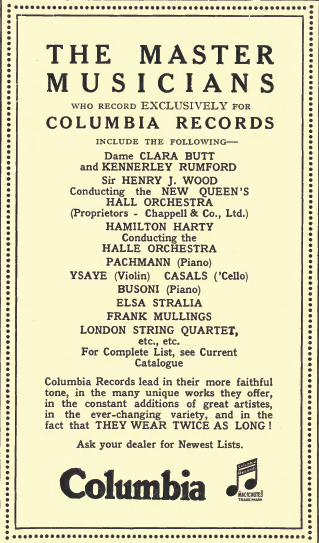
We’ve stumbled across a wonderful book called “The Talking Machine Industry” written by Ogilvie Mitchell in 1924. It is a bit of a hack job to be frank. Mr Mitchell’s style is frothy and he gallops across a range of subjects to do with the history of recorded music at that point (i.e. less than 50 years after Edison invents the phonograph). The book is one of a series of books about Common Commodities and Industries and appears to have been partly financed by adverts from the industry in question (and in return features some product placement). Long since out of print, it’s a fascinating read. We particularly enjoyed the review of the four big UK companies of the day and will reproduce a section about each of the big four over the next few days. This is the second instalment covering the Columbia Phongraph Company.

“In 1899 The Columbia Phonograph Company was established in Washington, U.S.A., thus it may be said to be among the very earliest of the concerns to enter the industry, and it has been one of the most successful. As early as 1887, however, the parent company of the Columbia, and literally the pioneers in the industry, had put machines and cylinders on the market under licence from Bell and Tainter. Being unable to carry out some of their contracts, the American Company made arrangements with several others in the various States to act as sales-agents, while the original company limited their efforts to the manufacturing side.The Columbia Company secured one of these sales-agencies, and were restricted by agreement to the three States of Columbia, Delaware and Maryland. This restriction did not last long, however, for the prosperity of the Columbia was such that presently it ousted all the other agencies, extending its business throughout the whole of the United States. Not content with that, it opened branches all over the world and subsequently swallowed up the American Graphophone Company itself.

Here it may be noted that, as we fancy we have mentioned before, it was T. H. Macdonald, of the Graphophone Company, who perfected the spring motor. Up till then electricity had been used for the driving power, but with the clockwork mechanism methods were simplified and the cost of machines considerably cheapened.

When the Columbia Company removed their chief offices from Washington to New York, Mr. Frank Dorian was placed in charge as general manager. This move occasioned a vast expansion of trade and Mr. Dorian was sent to Paris to superintend the establishment of the European connection . His energy proved invaluable. Rapid strides were made in Paris and a branch was soon opened in Berlin. The following year the London business was reorganized and its headquarters formed in a five storey building in Oxford Street This was made the controlling centre for Europe, and Columbia was flourishing like the green bay tree, Later their swiftly developing progress warranted a removal to larger premises in Great Eastern Street, closer to the seat of the British trade which lies in that neighbourhood. At that time, of course, their records were all cylinders, but they were doing admirable work.

It was about this time that they contrived to obtain a record of the voice of Pope Leo XIII, a circumstance which we have already noted. It was issued almost on the very day of the venerable Pontiff’s death, and so made a great sensation in Catholic circles. They also secured some valuable cylinders of famous singers of the time, and set a fashion later developed by the discs of the Gramophone Company.

Finding that, in England, the disc was superseding the cylinder, the Columbia built a factory at Wandsworth and started manufacturing lateral cut records. It was an excellent step on their part, for they got hold of some of the best voices and instrumentalists in the kingdom and their productions had a great vogue. This company has played a conspicuous part in the fortunes of the industry here, doing excellent pioneer work in various directions, and aiming to elevate the public taste in gramophone music.

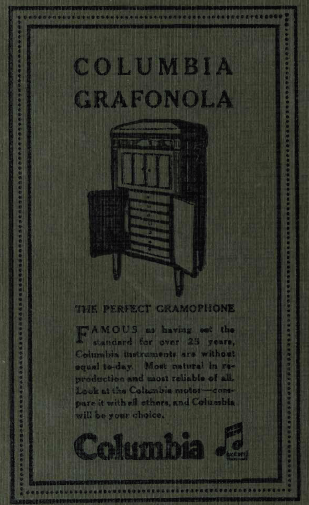
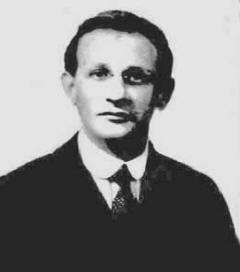
With the advent of Mr. Louis Sterling (above) as European manager of the company fresh life was imparted into the business, and their instruments, the celebrated Grafonolas, have a great sale, while the records find purchasers by the million. The Regal, a cheaper record, is also issued by them and is much appreciated by gramophone users whose purses are not so well filled as those of the purchasers of the higher grade Columbia.

The Four Major record companies in the UK (in 1924). #1

We’ve stumbled across a wonderful book called “The Talking Machine Industry” written by Ogilvie Mitchell in 1924. It is a bit of a hack job to be frank. Mr Mitchell’s style is frothy and he gallops across a range of subjects to do with the history of recorded music at that point (i.e. less than 50 years after Edison invents the phonograph). The book is one of a series of books about Common Commodities and Industries and appears to have been partly financed by adverts from the industry in question (and in return features some product placement). Long since out of print, it’s a fascinating read. We particularly enjoyed the review of the four big UK companies of the day and will reproduce a section about each of the big four over the next few days, starting now with The Gramophone Company – the predecessor company to the modern EMI.

“In England at the present time there are four companies manufacturing the higher priced records. Of these The Gramophone Company, Ltd., undoubtedly holds the field. The history of this extensive concern has already been referred to cursorily in a previous chapter, but we would like to lay before the reader a more comprehensive chronicle of its origin and rise. Like most of the other large firms engaged in the industry The Gramophone Company began its career in America. As previously stated, Berliner was the man who gave the term “gramophone” to his invention of a disc machine, though he never claimed an exclusive right thereto. In 1896 or 1897 Berliner sold his English patent rights, including, it is said, his rights in respect of certain patented improvements, to a private firm calling itself The Gramophone Company, taking its name from the instrument. In 1899 this concern transferred its business to a company incorporated under the style of The Gramophone Company, Limited, the object of which, as defined by its Memorandum of Association, embraced, inter alia, the manufacture and sale of gramophones and phonographs and gramophone discs and phonograph cylinders. The last mentioned firm continued to sell machines and discs made under Berliner’s patent until the following year, when it parted with its business to a company with a larger capital. This new concern had about the same time acquired an interest in typewriters, and was incorporated as The Gramophone and Typewriter Company, Limited. The same year the Tainter-Bell patent expired, and the engraving method being considered superior to etching, the company abandoned the latter process and adopted the former, continuing, however, to use the name of gramophone. There was nothing wrong in that, for the essence of the Berliner system was the sinuous line of even depth and the word “gramophone“ had come to denote a disc talking machine, as opposed to the phonograph and graphophone which were at that time operated by cylinders.

The Gramophone and Typewriter Company established a branch in England almost as soon as it was inaugurated, with Mr. Barry Owen as its representative, and some time afterwards dropped the typewriter section of the business, reverting to the old title of The Gramophone Company, Ltd. They had their offices in Maiden Lane, Covent Garden, and so rapid was the growth of this British branch that a company was formed with a share capital of £600,000, the ordinary shares in the first instance being offered to the trade. Thereupon they removed to the City Road where they remained in full swing until the extensive works at Hayes, Middlesex, which were opened in 1907, were ready to receive the army of workers of every description attached to the firm. This enormous factory has been enlarged and developed since that date until it now covers twenty-three acres of ground.

Ever since the expiry of Berliner’s 1887 patent The Gramophone Company had arrogated to itself the sole right to the term “gramophone.” In its dealings with the trade it had consistently claimed monopoly rights in the word as denoting goods of its own manufacture only, and by warning circulars, legal proceedings and threats of legal proceedings, had done its best to support its exclusive claims. Other manufacturers refrained from describing their instruments as gramophones from the dread of infringing the alleged rights of the company. The gigantic bubble, however, was destined to be pricked.

In the year 1910 the company applied for power to register the term “gramophone” as applicable solely to the wares manufactured and dealt in by them. The most memorable case ever heard of in the talking machine world of this country ensued. It came before Mr. Justice Parker and lasted four days. Experts, legal and otherwise, were called, examined and cross-examined. The court was crammed with all the leading lights of the trade, who were there either as witnesses or as spectators. At length judgment was pronounced Power was refused, and the word “gramophone” became the property of anyone who had a disc machine to sell. A verbatim note of the whole proceedings was taken at the time by the Talking Machine News, and was published the morning after judgment was delivered. It was the only paper that printed the case in extenso.

In legal matters The Gramophone Company have been rather unfortunate, for previous to the case we have spoken of they lost one over the Gibson tapering tone arm in 1906. This was an invention for which they claimed sole rights. These were disputed and the action went against them. Nevertheless, if they have been unlucky in the courts it cannot be denied they have been marvellously successful in business. Before the war there were subsidiary companies in various capitals of Europe, and they were connected with the great Victor Company of America, which has now a large controlling interest in the concern. The Zonophone Company, too, has been absorbed by this firm.

During the war a portion of the huge factory at Hayes, the foundation-stone of which, by the way, was laid by Madame Tetrazzini, was given over to the manufacture of munitions. It is believed that The Gramophone Company was the first industrial concern, not normally engaged on Government contracts, to convert their plant. Within ten days of the declaration of war, the output of certain essential fuse parts was commenced. These required extraordinary accuracy and the mechanism at command of the company enabled them to make a beginning almost at once.

Of the artists exclusively engaged to make the famous “His Master’s Voice” records for the company we shall speak later, and in the chapter devoted to the “Talking Machine as a Teacher ” we shall have something to say of the firm’s efforts in that direction.”

We’ve been trying to find more information about the author but little is available. He appears to have written several pulp novels around the turn of the twentieth century and at least one song called Heroes. (Not the same song as was later recorded by David Bowie!)